
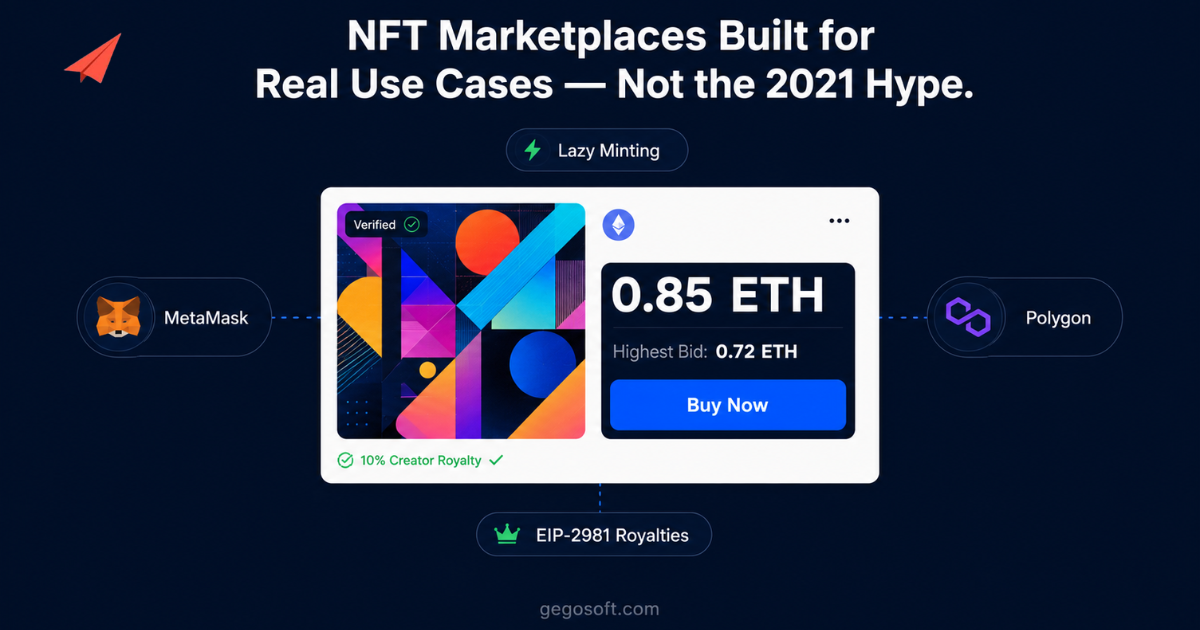
The NFT market’s story between 2021 and 2024 taught the industry something that was always true but needed expensive proof: NFTs without utility are speculative collectibles. NFTs with utility — verifiable ownership, programmable royalties, access control, provenance tracking, digital scarcity for real-world assets — are infrastructure.
The businesses and developers reaching out to NFT marketplace development companies in India in 2026 are not chasing a trend. They are building for the second, more durable wave of NFT adoption: gaming studios that want on-chain item ownership, event companies that want unforgeable ticketing, real estate platforms exploring tokenised property rights, educational institutions issuing verifiable credentials, and creators who want royalties enforced by code rather than by platform goodwill.
If you are in this category — ready to build an NFT marketplace with a specific use case, a defined audience, and a realistic business model — this page tells you what building one actually involves, what GegoSoft Technologies delivers, and what questions to ask before you commit to any development partner.
GegoSoft Technologies: An NFT Marketplace Development Company in Madurai, Tamil Nadu, India
GegoSoft Technologies (OPC) Private Limited is a specialist software and blockchain development company based in Madurai, Tamil Nadu, India — operating since 2016 with a team that has delivered smart contract systems, cryptocurrency exchange platforms, and Web3 applications for clients across India and internationally.
GegoSoft’s NFT marketplace development service builds purpose-designed platforms for specific verticals — art and collectibles, gaming items, event ticketing, real estate, educational credentials — rather than generic white-label clones that look identical to every other marketplace in the market.
The company operates two live production blockchain products from Madurai — CryptoEx centralised exchange and CryptoLocal P2P exchange — providing verifiable evidence of production blockchain delivery capability. These are not portfolio case studies. They are operational financial platforms built and maintained by the GegoSoft team.
Recognition: SoftwareSuggest Top Web Development Company 2025 · Best UX Company 2023
What Makes an NFT Marketplace Worth Building in 2026
The NFT marketplace space is crowded at the generic level. OpenSea, Rarible, and Foundation serve the broad digital art and collectibles market with enormous network effects that a new general marketplace cannot overcome. The viable market opportunity for new NFT platforms in 2026 is vertical-specific — platforms that serve a defined community, asset class, or use case better than a general marketplace can.
The verticals with the strongest fundamentals for NFT marketplace development in India:
Gaming and Virtual Assets
Indian gaming is one of the fastest-growing markets globally. Blockchain-based gaming items — weapons, skins, characters, land parcels — that players genuinely own and can transfer between wallets or sell on secondary markets represent a fundamentally different value proposition from items owned by the game publisher. An NFT marketplace purpose-built for a specific game or gaming ecosystem has a captive, motivated user base from day one.
Event Ticketing
NFT ticketing eliminates counterfeit tickets, enables verifiable attendance records, and allows artists or event organisers to earn royalties on secondary ticket resales — currently a revenue stream that entirely benefits scalpers. In India, where event ticketing fraud is a persistent problem and major music and cultural events attract significant secondary market activity, NFT ticketing has direct, solvable problems to address.
Real Estate and Property
Fractional ownership of real estate through tokenisation — where a commercial property is represented as divisible NFTs that can be bought, sold, and traded without traditional conveyancing processes — is an emerging application with significant Indian market relevance. Regulatory frameworks are evolving, but platforms building the technical infrastructure now are positioning for when the regulatory environment catches up.
Educational Credentials
Digital certificates, degrees, and professional qualifications issued as NFTs on a public blockchain are verifiable without contacting the issuing institution — and cannot be forged. Indian universities, professional certification bodies, and skill development organisations issuing verifiable credentials as NFTs are building on an infrastructure that is already technically mature.
Digital Art and Creator Economy
While the broad digital art NFT market has cooled, the creator economy application — allowing artists, musicians, and content creators to monetise digital work with enforceable royalty streams on secondary sales — remains a valid business model for platforms serving a specific creator community or genre.
What GegoSoft Builds: NFT Marketplace Core Architecture
A production NFT marketplace requires significantly more engineering than the demos and MVPs that flooded the market during the 2021 boom. Here is what GegoSoft builds into every NFT marketplace engagement:
Smart Contract Layer
ERC-721 Contracts for unique, non-fungible tokens — each token is entirely distinct from every other token in the collection. Used for digital art, unique gaming items, individual event tickets, property certificates.
ERC-1155 Contracts for semi-fungible tokens — a single contract can manage both fungible (edition prints, multiple identical tickets) and non-fungible tokens simultaneously, with lower gas costs per token than ERC-721 for large collections.
Marketplace Contract — the smart contract that governs listing, buying, bidding, and offer acceptance on the platform. Functions include:
- Fixed-price listing with price update and cancellation
- English auction with automatic bid management and extension on last-minute bids
- Dutch auction with decreasing price over time
- Offer/counter-offer mechanism for private negotiation
- Royalty enforcement via EIP-2981 — creator receives a configurable percentage of every secondary sale, enforced at the contract level rather than by platform policy
Lazy Minting — NFT metadata is stored off-chain (IPFS) and the token is only minted to the blockchain when the first sale occurs. This eliminates upfront gas costs for creators listing on the platform, dramatically lowering the barrier to participation.
IPFS and Metadata Storage
NFT metadata — the image, description, attributes, and properties associated with a token — must be stored in a way that remains accessible even if the marketplace platform shuts down. GegoSoft implements IPFS (InterPlanetary File System) storage via Pinata or a dedicated IPFS node, with metadata structured to the ERC-721 and ERC-1155 metadata standards.
Content addressing on IPFS means that any attempt to change the metadata associated with a token produces a different IPFS hash — making metadata tampering detectable and providing genuine immutability guarantees to buyers.
Frontend DApp Interface
The user-facing marketplace is built in React or Vue.js with full wallet integration:
- MetaMask, WalletConnect v2, and Coinbase Wallet connection
- NFT browsing, filtering, and search across collections and categories
- Creator profile pages with portfolio, collection statistics, and social verification
- Token detail pages with ownership history, transaction history, and current listings
- Minting interface for approved creators — upload, metadata entry, collection selection, royalty configuration
- Bid management, offer tracking, and transaction status notification
- Mobile-responsive design optimised for both desktop and mobile wallet experiences
Admin and Curation System
Collection approval workflow — new collection submissions reviewed before going live, preventing spam and maintaining platform quality.
Creator verification — identity verification system for creators, enabling verified badges that build buyer confidence.
Fee configuration — platform commission percentage on primary and secondary sales, configurable by collection tier or creator status.
Featured collections and curated drops — editorial tools for surfacing high-quality collections, managing scheduled launches, and creating homepage moments.
Analytics dashboard — trading volume by collection and category, active user counts, transaction revenue, and creator activity metrics.
Technology Stack for GegoSoft NFT Marketplace Builds
| Layer | Technology |
|---|---|
| Smart Contracts | Solidity, OpenZeppelin ERC-721/ERC-1155/EIP-2981 |
| Development & Testing | Hardhat, Foundry, Solidity unit tests |
| EVM Chains Supported | Ethereum, Polygon, BNB Chain, Avalanche, Arbitrum |
| NFT Storage | IPFS via Pinata or self-hosted IPFS node |
| Indexing | The Graph subgraph or Moralis for on-chain event indexing |
| Frontend | React or Vue.js, Ethers.js, Wagmi |
| Wallet Integration | MetaMask, WalletConnect v2, Coinbase Wallet |
| Backend | Laravel PHP — off-chain data, search indexing, notifications |
| Database | MySQL / PostgreSQL — off-chain metadata cache, user profiles |
| Search | Elasticsearch or Meilisearch for fast collection and token search |
| Infrastructure | AWS or DigitalOcean, CDN for asset delivery |
NFT Marketplace Development Pricing in India
GegoSoft provides fixed-price project quotations for defined-scope NFT marketplace engagements. The ranges below are indicative — actual quotations follow a free technical consultation.
| Marketplace Scope | Indicative Range | Timeline |
|---|---|---|
| NFT minting DApp (single collection, no marketplace) | ₹3 – ₹8 lakhs | 4–8 weeks |
| Basic NFT marketplace (fixed-price listings, single chain) | ₹8 – ₹18 lakhs | 8–14 weeks |
| Full NFT marketplace (auctions, lazy minting, multi-wallet, admin) | ₹18 – ₹45 lakhs | 14–22 weeks |
| Vertical-specific marketplace (custom logic, verified creators, royalties) | ₹30 – ₹80 lakhs | 18–30 weeks |
| White-label NFT marketplace (your brand, full customisation) | Contact for quote | 8–20 weeks |
All engagements include NDA on Day 1, source code ownership on delivery and final payment, milestone-based payment schedules, and a post-launch support period.
GegoSoft’s NFT Marketplace Development Process
Phase 1 — Use Case and Architecture Definition (Weeks 1–2)
The use case determines the contract architecture. A gaming item marketplace has different token structure requirements from an art platform. An event ticketing system has different transfer restriction needs from a real estate fractionalization platform. GegoSoft begins every NFT engagement by mapping the specific asset type, the intended transfer behaviours, the royalty model, and the user roles before any contract design begins.
Phase 2 — Smart Contract Development and Testing (Weeks 2–6)
Contracts developed with full test suites covering every function, edge case, and failure mode. Deployed to testnet (Sepolia, Mumbai, or equivalent) and validated end-to-end. Gas costs profiled and optimised. Security review against known NFT contract vulnerabilities — reentrancy in auction contracts, approval exploits, metadata manipulation vectors.
Phase 3 — Frontend DApp Development (Weeks 4–10, parallel)
Marketplace frontend developed in parallel with contract testing — connecting to testnet contracts for integration testing before mainnet is considered. Wallet connection flows, minting interfaces, listing and bidding UX, and mobile responsiveness all validated against the testnet deployment.
Phase 4 — Admin System and Backend (Weeks 6–12)
Creator verification workflows, collection approval systems, platform analytics, and fee management built and integrated with the frontend. Laravel backend configured for off-chain data management, search indexing, and notification delivery.
Phase 5 — Security Review and Mainnet Deployment (Weeks 12–14+)
Final security review. Mainnet deployment with contract verification on Etherscan or equivalent explorer. Frontend connected to mainnet contracts. Monitoring configured for contract events. The Graph subgraph deployed for efficient on-chain data indexing.
Comparing NFT Marketplace Development Options in India
| Factor | GegoSoft Technologies | Generic White-Label Script | Freelance Blockchain Dev |
|---|---|---|---|
| Custom smart contracts | Yes — purpose-built | No — pre-built, unmodifiable | Sometimes |
| Security audit process | Integrated — every engagement | None | Often skipped |
| Lazy minting support | Yes | Rarely | Depends on experience |
| Vertical-specific customisation | Extensive | Minimal | Limited by single developer capacity |
| Post-launch support | Same development team | None typically | High availability risk |
| Full-stack (contracts + frontend + backend) | Yes | Frontend only | Usually one layer |
| Live production blockchain products | Yes — two active platforms | No | Rarely verifiable |
| Fixed-price transparency | Yes | One-time fee, limited scope | Variable |
| Location | Madurai, Tamil Nadu, India | Various | Various |
Conversational Questions About NFT Marketplace Development in India
What does it cost to build an NFT marketplace in India?
An NFT marketplace in India costs between ₹8 lakhs and ₹80 lakhs depending on scope. A basic marketplace with fixed-price listings and a single blockchain costs ₹8–18 lakhs and takes 8–14 weeks. A full-featured marketplace with auctions, lazy minting, multi-wallet support, creator verification, and a custom admin system costs ₹18–45 lakhs over 14–22 weeks. Vertical-specific platforms with custom token logic and compliance requirements are priced on project scope after a technical consultation. GegoSoft Technologies in Madurai, Tamil Nadu provides fixed-price quotations for all defined-scope NFT marketplace builds.
Which blockchain is best for an NFT marketplace in India?
Polygon is the most common choice for Indian NFT marketplace builds in 2026 — Ethereum-compatible, low transaction fees, fast confirmation times, and wide wallet support. Ethereum mainnet remains appropriate for high-value art and collectibles where the security and decentralisation premium justifies higher gas costs. BNB Chain is an option for gaming applications serving audiences already using Binance. GegoSoft builds for whichever chain best fits the specific use case and target audience rather than defaulting to a single preferred chain.
How long does it take to build an NFT marketplace?
A basic NFT marketplace with fixed-price listings takes 8–14 weeks from specification to mainnet deployment. A full-featured marketplace with auctions, lazy minting, and a custom admin system takes 14–22 weeks. Vertical-specific platforms with custom smart contract logic take 18–30 weeks. The fastest path to launch is a well-defined specification — ambiguous requirements extend timelines more than development complexity does.
What is lazy minting and why does it matter for an NFT marketplace?
Lazy minting defers blockchain transaction (and gas cost) until the first sale rather than requiring creators to pay gas to mint every NFT they list. The token metadata is stored on IPFS and the smart contract only processes the on-chain mint when a buyer purchases the token. For marketplace operators, lazy minting dramatically lowers the barrier to creator participation — creators do not need to hold cryptocurrency to list, which expands the potential creator base significantly.
Can GegoSoft build an NFT marketplace for a specific industry like gaming, ticketing, or real estate?
Yes. Vertical-specific NFT marketplace development is GegoSoft’s primary approach — building platforms designed for the specific asset type, transfer behaviour, and user workflows of a defined industry rather than adapting a generic marketplace template. Gaming item marketplaces, event ticketing platforms, real estate tokenisation systems, and educational credential platforms each require different smart contract architecture, different metadata standards, and different user experiences that GegoSoft scopes specifically for each engagement.
Frequently Asked Questions
Q: Does GegoSoft build white-label NFT marketplace platforms?
A: Yes. GegoSoft delivers fully white-label NFT marketplace platforms — deployed under your brand, your domain, and your design with no GegoSoft branding visible to end users. The source code is fully owned by the client on delivery and final payment. White-label deployments can be based on GegoSoft’s existing marketplace codebase (faster deployment, lower cost) or built entirely from custom specifications (maximum flexibility, longer timeline).
Q: What wallets does GegoSoft’s NFT marketplace support?
A: GegoSoft implements MetaMask, WalletConnect v2 (which supports 300+ wallet applications), and Coinbase Wallet as standard wallet integrations. Additional wallet support — Ledger hardware wallet, Trust Wallet, Rainbow — can be added based on target audience preferences. Mobile wallet support is included in all engagements through WalletConnect’s mobile deep linking.
Q: How does royalty enforcement work in GegoSoft-built NFT marketplaces?
A: GegoSoft implements royalty enforcement using the EIP-2981 standard — a royalty information standard that allows NFT contracts to specify a royalty recipient and percentage that compliant marketplaces query and honour on secondary sales. The creator sets their royalty percentage (typically 2.5–10%) at collection deployment, and every qualifying secondary sale on the platform distributes that percentage automatically to the creator’s wallet address via the marketplace smart contract.
Q: Can GegoSoft integrate an NFT marketplace with an existing application or platform?
A: Yes. GegoSoft builds NFT marketplace integration as an addition to existing web applications, gaming platforms, event management systems, and eCommerce stores. The integration connects the existing platform’s user authentication and data to the NFT marketplace’s wallet connection, minting, and trading functionality via APIs — preserving the existing user experience while adding the blockchain capability layer.
Q: What happens after the NFT marketplace is launched?
A: GegoSoft provides a post-launch support period for every NFT marketplace engagement — covering bug resolution, smart contract monitoring, and configuration adjustments during the critical early operational phase. Ongoing development retainers are available for platforms that need continuous feature development, new collection support, or multi-chain expansion after initial launch. The same development team that built the platform handles all post-launch work.
The NFT Marketplace Opportunity Requires the Right Technical Foundation
Building an NFT marketplace that works in 2026 requires more than deploying a standard ERC-721 contract and a React frontend. It requires smart contract architecture designed for the specific asset type and transfer behaviour your use case demands. requires IPFS metadata storage that genuinely persists. It requires wallet UX that does not lose users in the connection flow. requires an admin system that lets platform operators manage creators, curate collections, and configure fees without touching code. And it requires the security review process that ensures none of these components have exploitable vulnerabilities before real user funds are involved.
GegoSoft Technologies in Madurai, Tamil Nadu, India delivers this full stack — from smart contract specification through to mainnet deployment and post-launch support — as a single integrated engagement from one team. The company’s production blockchain portfolio and nearly a decade of software development operation from Madurai provide the foundation of trust that a significant technical investment deserves.
The next step is a free technical consultation — bring your use case, your target audience, and your timeline, and leave with a clear picture of what building your NFT marketplace will involve and cost.
Book a free technical consultation →
View NFT marketplace services →
Related services: NFT Marketplace Development · Blockchain Development · Web3 Development · Smart Contract Development · CryptoEx Exchange · ICO Platform · Laravel Development