
Laravel development, delivered on the TALL Stack
Laravel does the work that matters — data, security, billing, integrations. Tailwind, Alpine and Livewire put a reactive interface on top of it without dragging a separate JavaScript application into your project.
We are a Laravel company. TALL is how we ship the front of it.
Laravel has been our primary backend framework since GegoSoft started in 2017. Every product we own runs on it, and most of the client systems we maintain for teams in the US, Australia, Europe and Dubai run on it too. The TALL Stack matters because it lets a Laravel team build the whole application — instead of hiring a second team to build a React front end that talks to it over an API you now also have to maintain.
- One codebase, one deployment, one set of tests
- Business logic stays in PHP where your rules already live
- Server-rendered pages that search engines read without a workaround
- Internal code libraries we reuse across projects, so MVPs start ahead
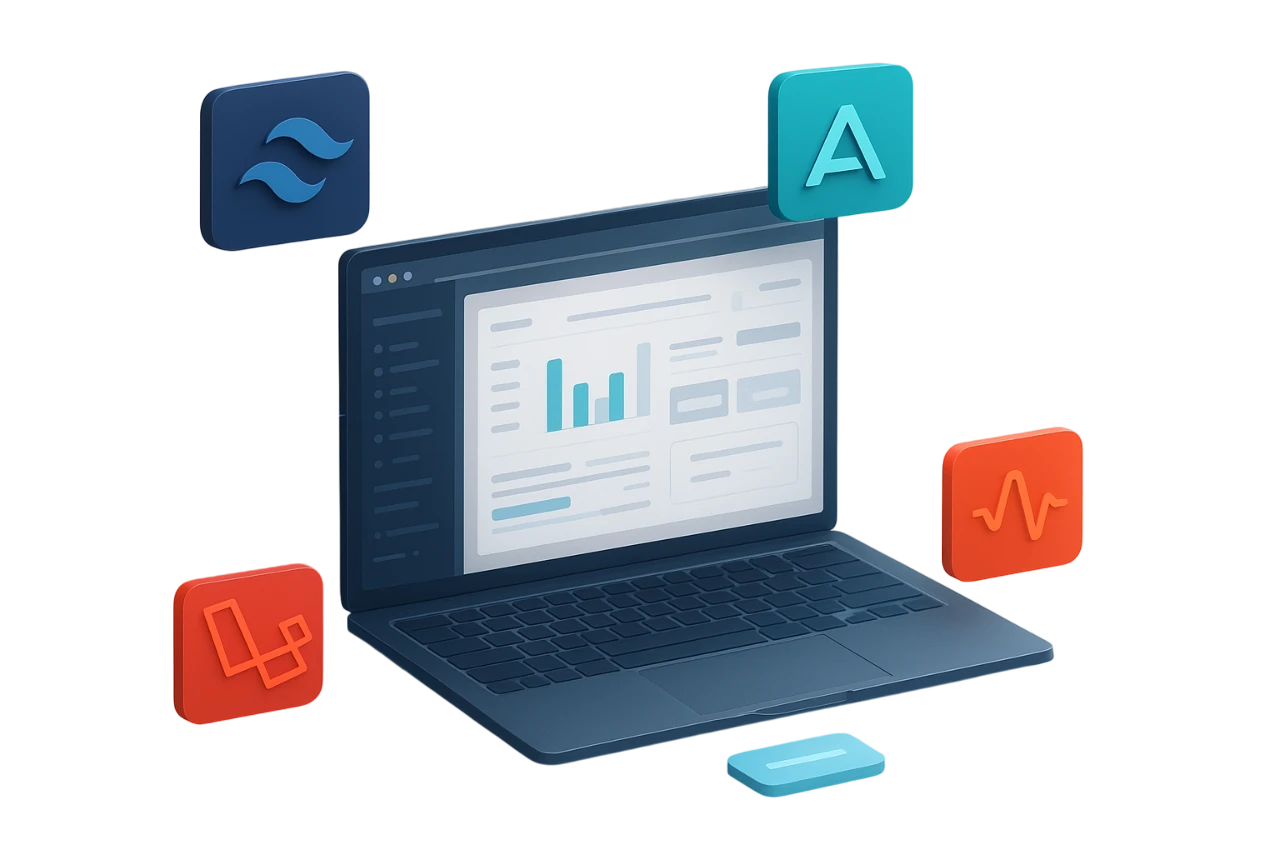
What each layer is actually for
TALL is a full-stack ecosystem built around Laravel. Four tools, each doing one job, with no overlap between them.
Laravel
BACKENDA mature PHP framework with authentication, authorisation, queues, scheduling, caching and API tooling built in. Eloquent handles the data model, migrations keep schema changes reviewable, and the ecosystem covers everything from billing to full-text search. This is where your application lives. laravel.com
Livewire
REACTIVITYComponents written in PHP that update in the browser over AJAX. You get live search, inline validation, multi-step forms and real-time tables without a separate front-end application, a build pipeline for it, or a second language in the repository. livewire.laravel.com
Tailwind CSS
INTERFACEA utility-first CSS framework. Spacing, type and breakpoints come from one design token set, so screens stay consistent as the app grows and nobody inherits a stylesheet full of dead rules. Unused classes are stripped at build, keeping the shipped CSS small. tailwindcss.com
Alpine.js
BROWSER BEHAVIOURA small JavaScript library for the interactions that shouldn't need a server round trip — toggles, dropdowns, modals, tabs. It sits in your markup rather than in a build system, which keeps page weight and complexity down. alpinejs.dev
Laravel work we take on
Whether it's a first version, a rescue, or a decade-old codebase that needs a future.
SaaS MVP build
Multi-tenancy, subscription billing, roles and an admin panel — assembled from libraries we already own, so the first release ships in weeks rather than quarters.
Custom Laravel applications
Internal systems, portals and workflow tools built to your process. Banking, construction, education, chemical compliance and tendering are domains we already know.
Livewire modernisation
An existing Laravel app with Blade and jQuery, brought up to a reactive interface component by component. No rewrite, no freeze on feature work.
Product enhancement
Our own products — GegoK12, ChurchCMS, BOQ Manager, ChemTracker, eTender — extended and customised for your organisation instead of built from zero.
API & mobile backends
Laravel as the API layer behind Flutter, Kotlin or React Native apps. Sanctum or Passport for auth, versioned endpoints, documented contracts.
Legacy PHP migration
CodeIgniter, raw PHP or an unsupported Laravel version moved onto a current release, with the data intact and the business rules documented on the way through.
Our Laravel work is public. Read it before you hire us.
Most agencies ask you to trust a portfolio of screenshots. Two of our products are open-source initiatives running in real organisations, and the code is there to review — architecture, test coverage, commit history and all.
GegoK12 — School ERP
A complete school management system covering admissions, attendance, fees, examinations, timetables and parent communication. Twenty-plus international schools run it in production. It's our longest-lived Laravel codebase and the clearest picture of how we structure a large application.
Visit gegok12.comChurchCMS — Church ERP
Membership records, families, groups, events, contributions and communication for congregations that can't justify commercial licensing. Built on the same Laravel foundations as GegoK12 and released openly for churches and their volunteer administrators to run themselves.
Visit churchcms.appWhen TALL is the right call — and when it isn't
TALL suits most business applications. It doesn't suit all of them, and we'd rather say so at the proposal stage than halfway through a build.
Choose TALL for
- Admin panels, dashboards and internal tools
- SaaS products with form and table-heavy screens
- ERP, CRM and workflow systems
- Marketplaces and portals that need to rank in search
- Teams whose developers already know PHP
- Projects where one team must own the whole stack
Consider something else for
- Offline-first or installable app experiences
- Canvas-heavy editors, drawing tools and games
- Interfaces needing sub-100ms local state on every keystroke
- Apps sharing a component library with an existing React front end
- Real-time collaborative editing with many concurrent writers
In those cases we still build the backend in Laravel and pair it with React, Next.js or NestJS on the front — which is work we do every week on other projects.
Why teams move to this stack
A working version, sooner
Reusable components and our own internal libraries mean the first demo is a real application on real data, not a clickable mockup you can't test.
Security handled at the framework level
Laravel covers SQL injection, CSRF and XSS by default, with hashed credentials and token-based APIs. You're not depending on every developer remembering every rule.
Reactive screens without a SPA
Livewire updates components over AJAX while the logic stays in PHP. Users get a modern interface; your team maintains one codebase.
Consistent on every screen size
Tailwind's breakpoints and token system keep spacing and type coherent from phone to desktop, including the screens added two years after launch.
Pages that load light
Alpine adds a few kilobytes instead of a framework bundle. Lower page weight means better Core Web Vitals, which search engines measure and rank on.

Maintainable in year three
Migrations, queues, tests and a conventional structure mean the next developer — ours or yours — can read the codebase instead of reverse-engineering it.
An AI-assisted team, not an AI-generated codebase
All eighteen engineers at GegoSoft use Claude Code as daily tooling. It accelerates scaffolding, test writing, refactors and code review — every line still passes through an engineer who owns it. That's what lets us quote a Laravel build at a realistic timeline without cutting the parts that matter.
Scope and data model
We map entities, roles and workflows before writing code. Most project failures start here, not in the framework.
Foundation
Repository, environments, CI, auth, tenancy and the Tailwind design system — set up once, properly.
Feature sprints
Livewire components built module by module against a staging URL you can open and test any day of the week.
Hardening
Automated tests, query profiling, queue tuning, security review and a load check against your expected traffic.
Launch and handover
Deployment, monitoring, documentation and training. Then a support retainer, or a clean exit with everything in your repository.
Frequently asked questions
Why choose the TALL Stack over MERN or MEAN?
Can you migrate an existing Laravel project to the TALL Stack?
Is Laravel suitable for enterprise applications?
Do we still need React or Vue alongside TALL?
Does a TALL application work with mobile apps and APIs?
What makes GegoSoft different from other Laravel agencies in India?
Can we start from one of your existing products instead of from scratch?
Bring us the problem, not the spec.
Describe what the system has to do and we'll tell you whether TALL is right for it, what it takes to build, and what it costs to run afterwards.