
Home / Products / Chemical labelling and inventory software

ChemTracker · Chemical manufacturing
Chemical labelling software where the label knows what state the drum is in
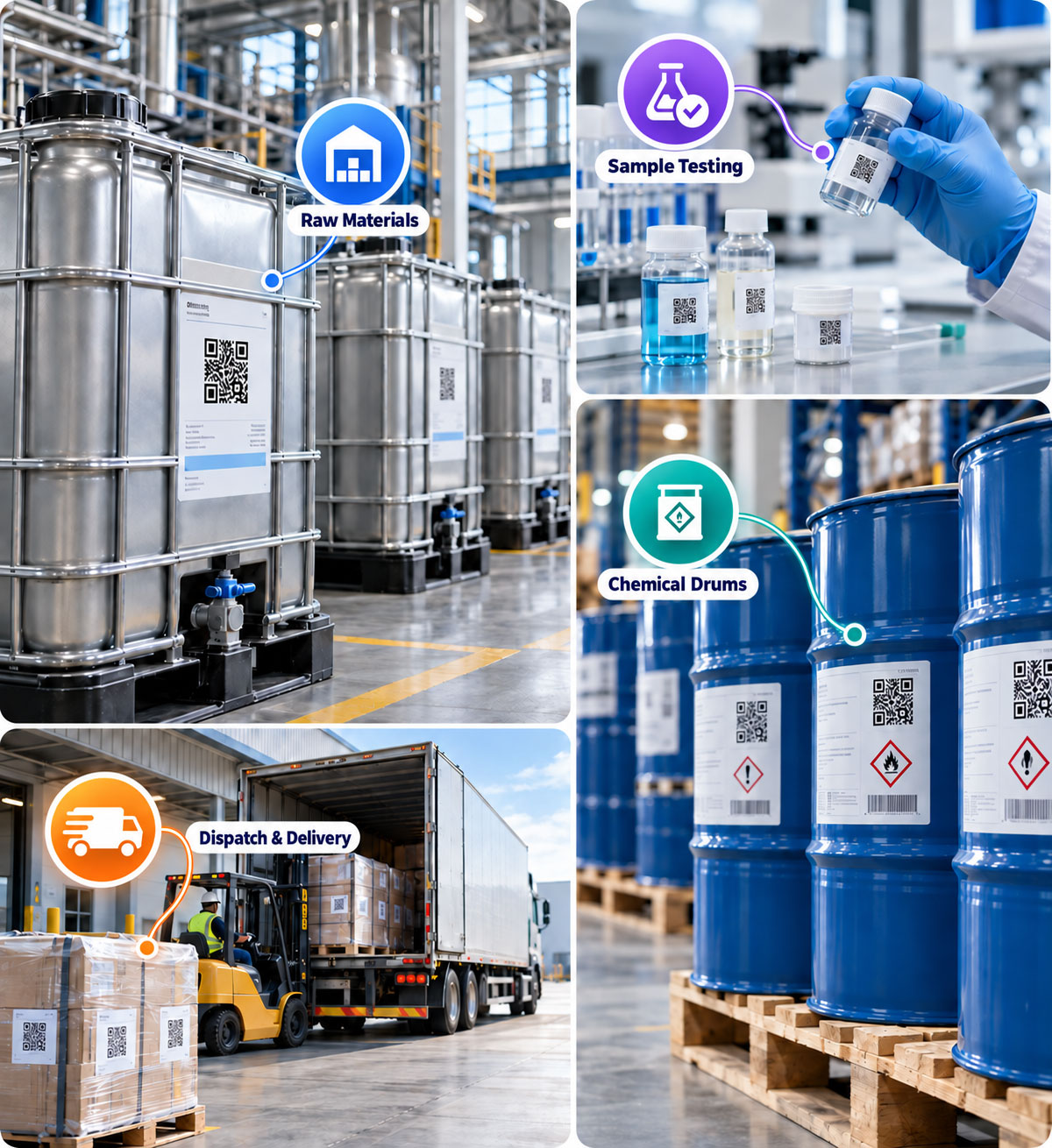
ChemTracker is chemical labelling and inventory software for manufacturers. Every container carries a QR-coded label tied to the live record, so scanning it at the receiving bay, the QA bench, the production floor or the loading dock returns the material's current status, its batch and order, and its handling instructions.
- Built for
- Chemical manufacturersNot laboratory EHS inventory
- Material types
- Raw, intermediate, finalOne catalog, one discipline
- Labels
- Admin define themTemplate master
- Stack
- Laravel + VueLaravel Nova admin
- Deployment
- Self Hosted
- Licence
- Commercial
The problem
The catalog, the QA log and the printed label disagree
In most plants these are three separate things. Chemical properties and handling instructions live in a document. QA results live in a register or a spreadsheet. Labels are printed from a design file that was last updated when someone remembered to.
What that costs you
Nobody trusts the drum
A container on the floor might be awaiting QA, released, or past its retest date. The only way to find out is to ask someone, and the answer depends on which record they check.
Retest dates are the sharpest version of this. A drum that quietly passed its retest date is a liability sitting in your warehouse, and on a spreadsheet nothing announces it.
What ChemTracker does instead
The label is the record
Properties, handling and storage instructions, testing procedure, retest date, CAS number and UN number sit on the chemical in the catalog. Every container printed from it carries a QR code back to that record and to its own batch.
Status changes as the material moves. The label does not go stale, because it is not a copy of the data — it is a pointer to it.
The mechanism
One customer order, followed end to end
A customer orders chemical X in quantity Y. Everything that follows is driven from that order, and every physical container along the way answers a scan.
01
Customer order
Order raised against the customer master for a catalog chemical and quantity.
02
Purchase order
Raw materials required for that order are purchased from suppliers on the master.
03
Receipt and label
Material received, a label generated from the template and applied to the container.
Scan returns: received, awaiting QA
04
QA sample
A portion is drawn for testing against the chemical's defined testing procedure.
Scan returns: under test
05
Status updated
Result recorded and a new status label issued. Released material moves to production.
Scan returns: released / rejected
06
Production
Work order consumes the released raw material. Output is logged as intermediate or finished product.
Scan returns: in production
07
QA and dispatch
Finished product tested again, then dispatched against the original order with a shipping label.
Scan returns: released, dispatched
At no point does anyone need to find the paperwork. A supervisor, a QA technician or a loading-dock operator scans the container and gets the current status, the order and batch it belongs to, and the handling instructions for that chemical.
The catalog
Raw material, intermediate and finished product, tracked the same way
Most inventory systems handle purchased goods well and treat everything between goods-in and goods-out as a gap. In a chemical plant that gap is where the value is created and where the risk sits.
Purchased from suppliers, received against a purchase order, labelled and QA-tested before it is allowed near production.
Produced by your own plant, and given the same catalog record, properties, label and status discipline as anything you bought.
Tested, labelled for shipping and dispatched against the customer order it was made for.
What a catalog entry holds
- Chemical name
- Chemical code and formula
- CAS number
- UN number
- Handling instructions
- Storage procedure
- Testing procedure
- Lifetime and retest date
- Shipping requirements
- Quantity types and units
Labels
You define the labels. We do not decide what your regulator wants.
Storage, testing and shipping labels are all defined by your plant in the template master and driven from the same chemical record. That matters more than it sounds.
Why it is built this way
Label requirements are local and they move
Different authorities, different customers and different destination countries want different things on a container. Software that ships one fixed format is software you wait on every time a requirement changes.
With a template master, your safety team builds the label. No development request, no release cycle.
What we do not claim
Templates, not certification
ChemTracker gives you the fields and the template designer. It does not certify that your label meets a particular standard, and we will not pretend otherwise — that judgement belongs to your safety and compliance function.
If your team needs a format built for them, we build it as a customisation.
What is in it
Six areas, all reading from the catalog
01
Catalog and properties
- Chemical master with full property set
- Raw, intermediate and final classification
- Handling, storage and testing procedures
- Lifetime and retest date per chemical
02
Labels and QR codes
- Template master for label design
- Storage, testing and shipping label types
- QR and barcode generation per container
- Scan returns live status and instructions
03
Orders and workflow
- Customer orders against the customer master
- Purchase orders to suppliers
- Work orders for production
- Dispatch orders against the original order
04
Quality control
- QA on receipt and on finished product
- Testing against the defined procedure
- Status change recorded and relabelled
- Rejected material tracked, not lost
05
Suppliers and customers
- Raw material supplier master
- Customer master with order history
- Invoicing and dispatch
- Purchase and sales records per material
06
Roles and audit
- Admin defines the catalog and templates
- Subadmins with permissions per order type
- Who raised, received, tested and released
- Audit trail across the chain
In use
What it looks like
Catalog · chemical properties
Template master · label design
Scan result · container status
How it is built
Built with chemical plants, not for an imagined one
ChemTracker is a Laravel application with a Vue front end, using Laravel Nova for the administrative layer. GegoSoft designed it with user experience work done first and validated it with real users on chemical factory floors — which is where the label-driven approach came from rather than from a feature list.
Our engineers use Claude Code as standard daily tooling for scaffolding, test generation, static analysis triage, refactoring and review passes. Architecture decisions, merge approval and production deployment stay with the engineers.
What is a setting and what needs development
| Area | Configuration | Needs development |
|---|---|---|
| Labels | Template design, fields, QR placement, label types | A new label output format or printer protocol |
| Catalog | Chemicals, properties, procedures, units, retest periods | New property dimensions in the data model |
| Roles | Subadmins, permissions per order type | New permission dimensions |
| Workflow | Who approves what, at which step | Additional stages in the status chain |
| Reports | Filters and exports | Statutory or customer-specific report formats |
| Integration | — | ERP, accounting or instrument integration |
Scroll the table sideways on a phone →
Fit
Who this is for, and who it is not
ChemTracker suits chemical manufacturers who buy raw materials, produce against customer orders, test at more than one stage, and have to label what leaves the gate.
Where it is the wrong tool
- You run a laboratory or university chemical inventory. That is a different problem — container-level stock for research groups, not order-driven manufacturing — and there are products built specifically for it.
- You need a full LIMS. ChemTracker records that testing happened and what the outcome was. It does not manage test methods, instrument data or lab workflows in depth.
- You want an ERP. It handles purchase, production and dispatch around the chemical. Statutory accounting belongs elsewhere, and integration is a customisation.
- You want us to guarantee your labels meet a standard. We supply the template designer; the compliance judgement stays with your safety function.
Questions
Frequently asked
What does chemical labelling software do that a label printer does not?
A label printer produces a printed artefact from a design file, and that artefact is out of date the moment the material's status changes. Chemical labelling software of this kind ties the label to a live record: the printed label carries a QR code, and scanning it returns the container's current status, its batch and order, and the handling instructions held against that chemical in the catalog. The label stops being a copy of the data and becomes a pointer to it.
Can we design our own label formats?
Yes. Labels are defined by the plant in a template master, covering storage, testing and shipping label types, all driven from the same chemical record. This matters because label requirements differ by authority, by customer and by destination country, and change over time. A plant that can build its own templates does not wait on a software release when a requirement changes.
Are the labels GHS compliant?
ChemTracker supplies the fields and the template designer; it does not certify that a label meets a particular standard. A plant can build a template carrying whatever pictograms, phrases and layout its regulator or customer requires, but the compliance judgement belongs to the plant's safety and compliance function. GegoSoft can build a specific format as a customisation if a team wants that done for them.
Does it track intermediates as well as purchased raw materials?
Yes. Raw material, intermediate and final product sit in the same catalog with the same property set, labelling and status discipline. An intermediate produced by your own plant is tracked exactly as rigorously as something you bought, which closes the gap most inventory systems leave between goods-in and goods-out.
How are retest dates handled?
Retest date and material lifetime are held against the chemical in the catalog and carried by each container. Because the label resolves to the live record, a container that has passed its retest date reports that on a scan rather than sitting silently in a warehouse until someone checks a spreadsheet.
Who can raise purchase, work and dispatch orders?
The administrator defines the catalog, the label templates and the roles. Subadmins are then granted permissions per order type, so the person raising purchase orders need not be the person releasing production or authorising dispatch. Every action is attributed in the audit trail.
Who builds and maintains ChemTracker?
GegoSoft Technologies, a software development company based in Madurai, India. It is a Laravel and Vue application built on Laravel Nova, designed with user experience work done first and validated with users on chemical factory floors.
Next step
Bring one of your own chemicals to the demo
The fastest way to judge this is to see a chemical you actually handle set up in the catalog, labelled, and followed through a status change. Tell us what you manufacture, how many stages you test at, and what your labels have to carry.