
NFT marketplace development, starting from a working demo
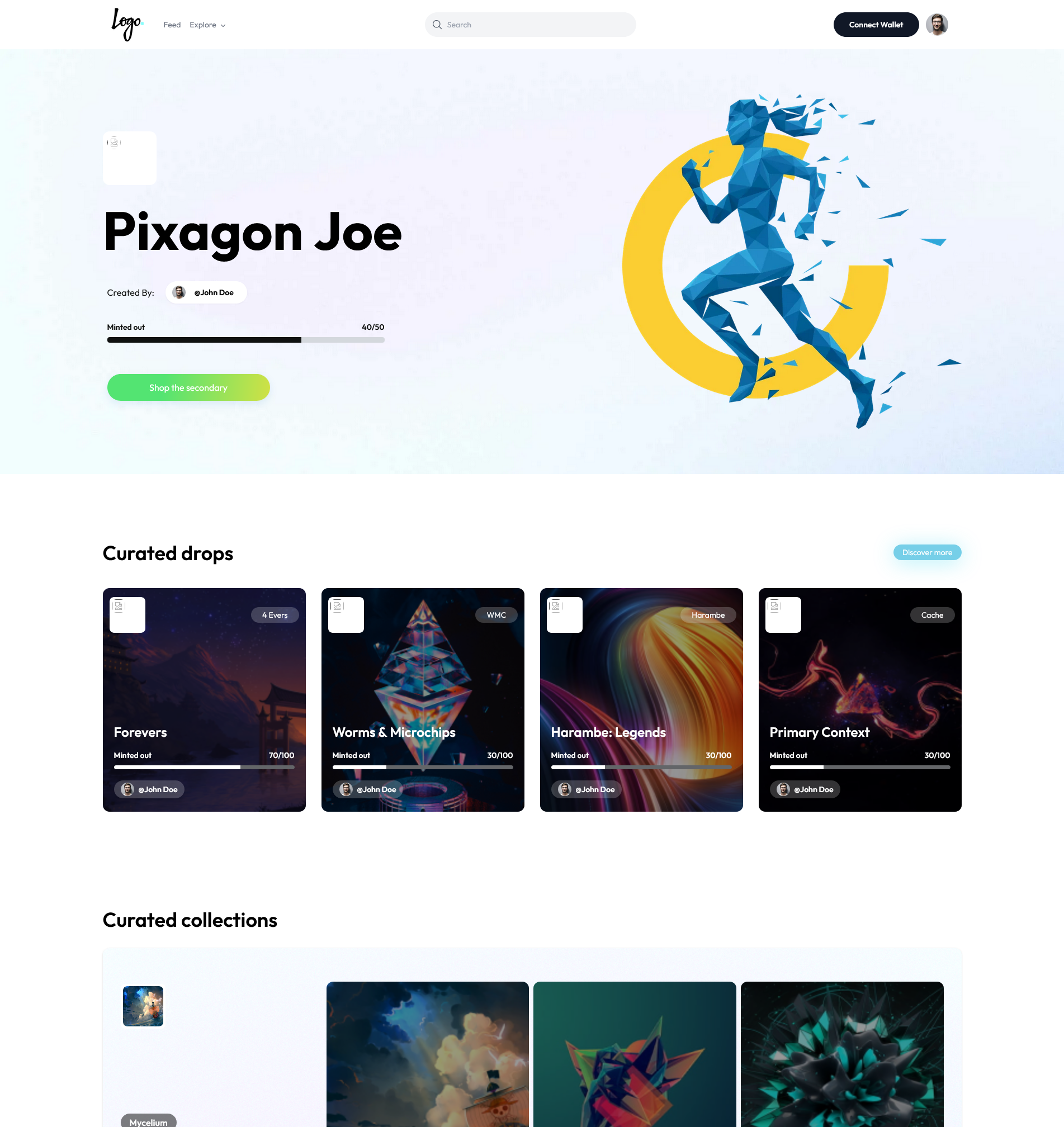
GegoSoft has built and maintains its own NFT marketplace engine — storefront, minting, auctions, royalties, IPFS storage and an operator admin panel. It runs on Ethereum testnet right now and you can use it before you commit to anything. We then customise it for your category, your chain and your compliance requirements.
Last reviewed: September 2026
- Who we are
- GegoSoft Technologies (OPC) Private Limited, a software company in Madurai, Tamil Nadu, India, established 2017. Eighteen engineers, with an in-house UI/UX team and Solidity developers.
- What we supply
- A white-label NFT marketplace engine we wrote and own, customised for your brand and category — not a resold script. Full source is handed over at the end of the project.
- What's included
- Storefront and collections, minting and lazy minting, fixed-price sales and auctions, royalty logic, wallet connection, IPFS metadata storage, KYC/AML hooks, and an operator admin panel.
- Built with
- React and Next.js with Tailwind on the front end, viem and wagmi for chain interaction, Solidity contracts on Ethereum and EVM chains, Node.js and MongoDB off-chain, IPFS for assets.
- Timeline
- Six to eight weeks for a branded marketplace on the existing engine. Fourteen weeks or more where contracts are custom and an independent audit is required.
- What we don't do
- Wash-trading features, artificial scarcity mechanics designed to manufacture urgency, or marketplaces whose economics depend on new buyers arriving to pay earlier ones.
What the marketplace engine already does
These modules exist and are running. Your project starts here rather than at an empty repository, which is where the six-to-eight week timeline comes from.

Storefront & collections
Homepage with featured drops and trending collections, collection pages, creator profiles and item detail pages with full ownership and price history.

Search & filtering
Search by item, creator, collection, token ID or contract address. Filter by price, traits, collection, listing type and auction end time.
Minting & lazy minting
Single and bulk minting, collection creation, trait definition, and lazy minting so creators pay no gas until an item actually sells.
Sales & auctions
Fixed-price listings, timed auctions, reserve prices, offers and counter-offers, with bid history visible and settlement handled on-chain.

Wallet & onboarding
MetaMask and WalletConnect, plus optional email-based onboarding through account abstraction for buyers who have never held a wallet.

IPFS storage & metadata
Assets and metadata pinned to IPFS with content identifiers written into the token, so what the NFT points to cannot be swapped after sale.

KYC & AML hooks
Identity verification at onboarding, sanctions screening and transaction monitoring, configured to the rules of the jurisdiction you register in.

Operator admin panel
Moderation queue, takedown handling for copyright claims, fee configuration, creator verification, featured placement and payout reporting.

Sharing & embeds
Permalinks with correct social preview cards, and an embeddable item widget that works on WordPress, Squarespace, Wix or plain HTML.
Three people use a marketplace, and they want different things
Most marketplace projects design for the buyer, half-design for the creator, and forget the operator entirely — then discover after launch that nobody can process a copyright takedown. GegoSoft was founded by a designer, and we design all three.
The buyer
WANTS TO NOT GET BURNED- Clear provenance — who minted it, who owned it, what it sold for and when
- Honest transaction states — pending, confirming, failed and reverted explained in plain words
- Total cost shown upfront — item price, gas and marketplace fee in local currency before they sign
- Verification badges that mean something, with the criteria published
- A report button on every item for copyright and impersonation claims
The creator
WANTS TO GET PAID- Minting that doesn't cost upfront — lazy minting so gas is only paid on a sale
- Bulk upload with trait mapping, not one item at a time
- Royalty terms stated plainly, including where they can and can't be enforced
- A profile worth having — bio, links, socials, portfolio and full sales history
- Payout clarity — what they earned, what was deducted, when it settles
The operator
RUNS IT EVERY DAY- Moderation queue for reported items with an audit trail of every decision
- Takedown workflow for copyright claims, because they will arrive
- Fee and royalty configuration without a developer or a deployment
- KYC review screen for approving, rejecting or escalating verification
- Financial reporting that reconciles with what actually settled on-chain
The royalty question you should ask every vendor
Creator royalties were the headline promise of NFTs in 2021. Since then the market has largely worked out that they aren't automatically enforceable, and any vendor still promising "guaranteed lifetime royalties" either hasn't kept up or is hoping you haven't.
How royalties actually work
The ERC-2981 standard lets a token declare a royalty percentage and recipient. It does not enforce payment. Whether the creator gets paid depends on whether the marketplace handling the resale chooses to honour that declaration — and many stopped, or made it optional, during the 2023 fee competition.
There are enforcement approaches: transfer restrictions via allowlists, or contract designs that block transfers to non-honouring marketplaces. They work, and they cost you something — reduced liquidity, and a fair objection from buyers that the asset isn't fully theirs. We'll implement whichever model you choose and tell you the trade-off before you choose it.
On your own marketplace, royalties on internal resales are entirely enforceable, because you control the settlement path. It's secondary sales elsewhere that you can't guarantee. That distinction should be in your creator terms, in writing.
KYC and AML are no longer optional in most markets
This changed materially between 2022 and now, and a lot of NFT marketplace content still online hasn't caught up. India brought virtual digital asset service providers under the Prevention of Money Laundering Act in March 2023, which carries registration, KYC, record-keeping and reporting obligations. The EU has moved in the same direction. Several other markets have their own rules.
What this means for your build
Identity verification, sanctions screening, transaction monitoring and record retention need to be designed in from the start, not bolted on when a bank or payment provider asks. Retrofitting KYC into a live marketplace with existing users is painful and expensive.
We build the hooks and integrate a verification provider suited to your market. We are engineers, not legal advisers — you need qualified counsel in every jurisdiction you operate in, and we'll tell you at which point in the project you need them.
An AI-assisted team, on contracts that hold other people's money
All eighteen GegoSoft engineers use Claude Code as daily tooling. On a marketplace it buys depth in the places that matter: the contracts custody assets and settle payments, and a bug there is permanent.
Test coverage the budget wouldn't normally allow
Unit tests, edge cases and fuzzing across minting, listing, bidding, settlement and royalty paths. Writing the hundredth test case is now cheap, so we write it.
Extra contract review passes
Reentrancy, access control, integer handling and auction-settlement logic read again before an engineer starts. A second and third set of eyes at low cost.
Front-end states nobody remembers
Wrong network, rejected signature, outbid mid-transaction, auction ended while confirming, insufficient balance. Enumerated and built, not discovered in production.
Documentation as we go
NatSpec and architecture notes written alongside the code. Auditors move faster through documented contracts, and audit hours are the expensive part.
Where the line is: AI writes drafts, tests and analysis. It never approves a merge or authorises a mainnet deployment. Named engineers own every contract, and anything custodying value goes to an independent third-party audit first.
White-label engine or custom build?
Both end with you owning the source. The difference is where you start.
| White-label engine | Custom build | |
|---|---|---|
| Best for | A standard marketplace in a new category or region | Novel mechanics, unusual assets, or deep integration with an existing platform |
| Timeline | 6–8 weeks to launch | 14 weeks and up |
| Contracts | Our audited base contracts, configured | Written for your model, independently audited |
| Design | Your brand applied to proven flows | Designed from research, every screen bespoke |
| Source code | Handed over in full | Handed over in full |
| What you trade | Structural changes cost more later | Longer to first revenue |
Technology stack
Current libraries, not what was standard in 2021. Web3.js has been deprecated by its maintainers; we build new work on viem and wagmi.
| Layer | What we use | Why |
|---|---|---|
| APPLICATION | ||
| Front end | React · Next.js · TypeScript · Tailwind CSS | Server rendering for SEO on item pages, which matters more than most marketplaces realise |
| Chain interaction | viem · wagmi · ethers.js | Typed, actively maintained, far smaller bundles than the deprecated Web3.js |
| Backend | Node.js · NestJS · MongoDB | Indexing, search, notifications and everything that shouldn't touch the chain |
| ON-CHAIN | ||
| Contracts | Solidity · OpenZeppelin · ERC-721 · ERC-1155 · ERC-2981 | Audited base libraries rather than hand-rolled token logic |
| Tooling | Foundry · Hardhat · Slither | Fast testing, fuzzing and static analysis on every commit |
| Networks | Ethereum · Polygon · Base · Arbitrum | Layer 2 for consumer volume; mainnet only where liquidity justifies the gas |
| STORAGE & OPS | ||
| Assets & metadata | IPFS · pinning service · CID in token URI | Content-addressed, so the asset an NFT points to can't be swapped after sale |
| Design & delivery | Figma · GitLab · CI pipelines | Prototypes you review before build; every change reviewed and traceable |
How a marketplace project runs
Model and jurisdiction
What's being sold, how you earn, which chain, who custodies assets, and what compliance that triggers where you're registered. Written up and yours regardless.
Demo review and gap list
You use the testnet demo properly and we build a list of what to change, add and remove. Much cheaper than specifying against a document.
Design and contract architecture
Brand applied across every screen and state, royalty and fee model decided, contract structure and upgrade strategy agreed.
Build on testnet
Customisation, integrations, KYC provider and admin panel, on a testnet URL your team can use daily.
Audit and hardening
Independent audit of anything custodying value, remediation, load testing and a security review of the admin surface.
Mainnet, handover, support
Deployment with verified source on the explorer, monitoring, full source handover, team training, then a support retainer if you want one.
Frequently asked questions
How long does it take to build an NFT marketplace?
What does NFT marketplace development cost?
Is this a clone script of OpenSea or Rarible?
Can creator royalties be enforced?
Do we need KYC and AML on an NFT marketplace?
Which blockchain should our marketplace run on?
Do buyers need a crypto wallet to use the marketplace?
Where are the NFT assets actually stored?
Do we own the code afterwards?
Where is GegoSoft located and do you work internationally?
Use the marketplace before you brief the project
Our demo runs on Ethereum testnet, so you can connect a wallet, mint, list, bid and buy with no real money involved. Fill in the form and we'll send the link.
- Connect a wallet and complete a full purchase flow
- Mint an item and list it for fixed price or auction
- See the creator dashboard and the operator admin panel
- Send us your change list — it becomes the project scope
Need testnet ETH to explore properly? Ask us on live chat or WhatsApp and we'll sort it out.
Related reading
Try it, then tell us what to change.
Most projects start with a client using the demo for a week and coming back with a list. That list is a better brief than any specification document.