
Most agencies that say they “use AI” mean one developer has Copilot turned on in one IDE. That’s not what happens here. Every one of our 18 engineers runs a Claude Code development workflow, every day, on every project. Laravel APIs, React dashboards, Next.js frontends, NestJS backends — all of it. This isn’t a pilot program. It isn’t a side experiment. It’s simply the standard way we work now.
This piece is not a sales pitch. It’s a walkthrough of what that actually looks like, hour by hour, warts included. If you’re evaluating an outsourcing partner, or trying to figure out whether “AI-assisted” is a real practice or just a label on an old process, this is the honest version.
Why We Structured Our Claude Code Development Workflow This Way
A few years ago, our process looked like most agencies’. A ticket got picked up. A developer wrote code. A senior dev reviewed it. Someone tested it. It shipped. Each step took as long as the person doing it needed, and that was fine for smaller jobs. But it wasn’t fine when we started delivering enterprise admin panels and multi-tenant SaaS backends on tight timelines for clients spread across four continents.
Here’s what we noticed: the bottleneck was never typing speed. It was the thinking that happens before typing. Mapping data models. Catching edge cases early. Deciding how a new feature fits into an existing Laravel or NestJS codebase without quietly breaking something three modules away. Typing was never the slow part. Thinking clearly, under time pressure, was.
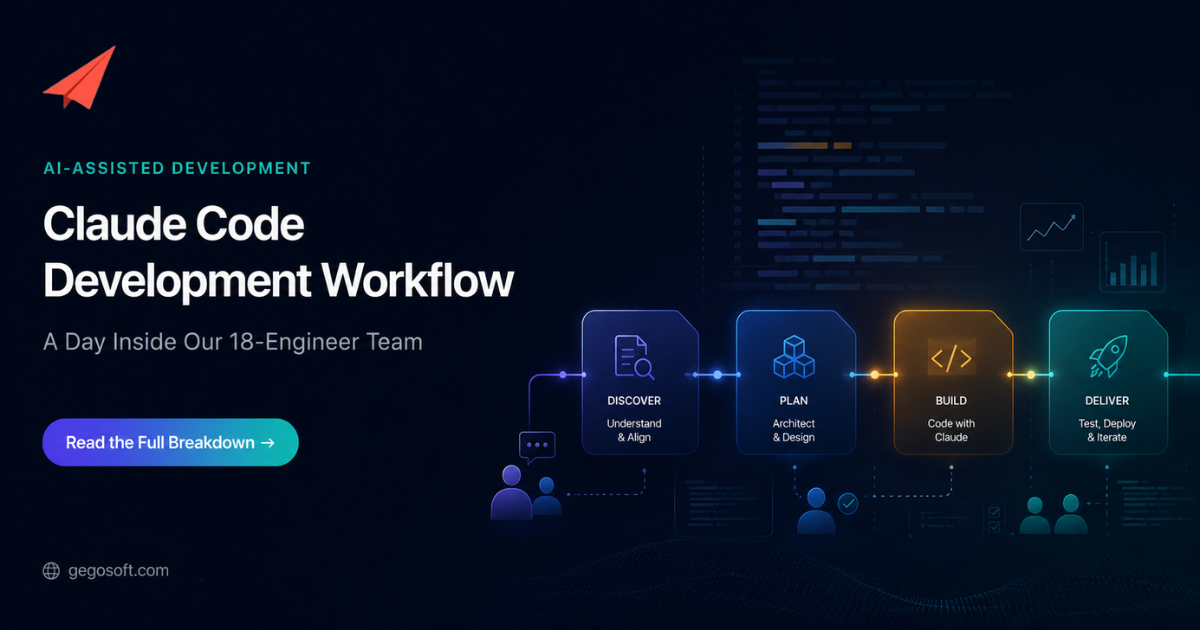
So we restructured the whole process around four stages instead of one continuous blur: Plan, Build, Review, Ship. Claude sits inside all four stages now, not bolted onto just one of them.
Stage One: Plan
Before anyone opens an editor, we map the feature out loud with Claude. That means walking through the data model, listing edge cases, and deciding exactly how the change touches existing code. For a recent multi-tenant billing feature, this single stage surfaced three proration edge cases that would otherwise have shown up as bug reports two sprints later, once real customers hit them.
To be clear, this isn’t Claude writing a spec unsupervised and walking away. An engineer drives the conversation the whole time. They push back on suggestions that don’t fit our architecture. They write the final plan themselves, in their own words. Claude’s real value here is breadth of context — it can hold an entire existing codebase in view and flag inconsistencies that a tired developer might miss on a Friday afternoon push.
Stage Two: Build
This is where most people assume “AI development” starts and ends. Honestly, it’s the smallest time saver of the four stages. Claude Code handles boilerplate: CRUD scaffolding, repetitive test setup, migration files, repetitive React component structure. That frees the engineer’s attention for business logic — the part that actually differentiates one client’s product from the next one.
Across Laravel, React, Next.js, and NestJS, the pattern holds steady. Claude writes a first pass. The engineer edits it against the plan from stage one. Nothing moves forward until it matches what a human decided the code should do, not what an autocomplete happened to suggest in the moment.
Stage Three: Review
Every pull request goes through Claude-assisted review before a human reviewer ever opens it. It checks for security gaps, obvious anti-patterns, and performance issues — the boring, easy-to-miss stuff that quietly eats up review time. Then a senior engineer reviews whatever’s left. Architecture decisions. Business logic correctness. Whether the change actually solves the client’s underlying problem, not just the ticket as written.
This ordering matters more than it sounds like it should. Human reviewers spend their limited attention on judgment calls instead of catching a missing null check for the tenth time that week. It’s the single biggest reason our review cycles got shorter without getting sloppier in the process.
Stage Four: Ship
Deployment itself hasn’t changed all that much. We still use the same CI/CD pipelines, the same staging environments, the same rollback plans we always have. What’s different is what arrives at this final stage. Fewer bugs slip through, because two review passes — AI, then human — caught most of them earlier. Technical debt also accumulates more slowly, because the plan stage forces real decisions up front instead of quietly deferring them to “later.”
What This Claude Code Development Workflow Doesn’t Fix
Being honest matters more here than sounding impressive. A Claude Code development workflow doesn’t replace architectural judgment. It doesn’t understand a client’s business the way an engineer who’s worked with them for two years does. It won’t stop a team from making a bad decision quickly — it just makes execution faster once the decision itself has already been made.
We’ve also had projects where Claude-generated code needed more rework than the plan predicted. This usually happens when an existing codebase has undocumented quirks that nobody flagged during planning. The fix wasn’t abandoning the workflow. It was tightening how much context we feed Claude before the build stage even starts, and being more thorough during the plan stage about codebase history.
There’s also a people side to this that doesn’t show up in any process diagram. Junior engineers need deliberate mentoring time that Claude can’t substitute for. Reading Claude’s suggested code critically is itself a skill, and it takes months to build well. We schedule that mentoring time explicitly now, rather than assuming it happens naturally on the job.
Measurable Differences We’ve Seen
Sprint velocity is the obvious metric here, but it’s not the most telling one. What changed more noticeably across the team:
- Fewer late-stage surprises. Edge cases surface during planning instead of during QA, when they’re far more expensive to fix.
- Shorter review cycles. Human reviewers spend their time on judgment calls, not repetitive syntax issues.
- More consistent code style across engineers. Claude nudges everyone toward the same patterns, and that matters a lot when 18 different people touch the same shared codebase.
- Faster onboarding on new client codebases. Claude reads an unfamiliar repository faster than a human can skim it, which shortens the ramp-up time on new outsourcing engagements considerably.
None of this means every project gets built in half the time. Complex integrations still take the time they take. Payment gateways, legacy system bridges, anything where “it depends on the client’s existing mess” applies — those don’t get faster just because AI is in the loop somewhere. AI-assisted doesn’t mean AI-solved, and we try never to promise otherwise.
We also track a quieter metric that rarely makes it into agency marketing: engineer satisfaction. Boilerplate work is tedious, and most developers didn’t get into this field to write repetitive CRUD scaffolding by hand. Removing that grind hasn’t made anyone redundant. It’s shifted attention toward the architecture and problem-solving work that made people want to become engineers in the first place. That matters for retention, and retention matters for clients who want the same team across a multi-year engagement instead of a rotating cast of new faces every few months.
How This Workflow Handles Disagreement
Not every engineer agreed with this change immediately, and that’s worth mentioning honestly. Some senior developers were skeptical that AI-assisted review would catch anything a good linter couldn’t. In practice, it catches more, because it reasons about intent rather than just syntax patterns. But that skepticism was reasonable going in, and we didn’t dismiss it. We ran the new workflow alongside the old one for a full sprint cycle before making it standard, specifically so skeptical engineers could compare the two directly rather than take our word for it.
Where This Fits Into How We Work With Clients
Clients don’t hire us because we use Claude Code. They hire us because our software development services — Laravel builds, React and Next.js frontends, NestJS backends, complex payment integrations — need to arrive on time and hold up under real usage once launched. The workflow above is how we get there consistently across an 18-person team, instead of depending entirely on any one senior developer’s personal habits and memory.
If you want to see the kind of work this workflow produces day to day, our portfolio covers admin panels, dashboard applications, and integration work across the industries we build for regularly. And if you’re sizing up whether an AI-assisted team is the right fit for what you’re building next, you can read more about who we are first, or go straight to starting a conversation about your project.
The Honest Takeaway
A Claude Code development workflow isn’t a magic multiplier, and it isn’t a marketing gimmick either. It’s a genuine shift in where engineering time gets spent. Less time goes toward boilerplate and easy-to-miss review items. More time goes toward the decisions that actually determine whether software works well for the people who end up using it every day.
That’s the version of “AI-assisted development” worth paying attention to. Not the pitch on a homepage. The process behind it.
Curious what this looks like applied to your specific project? Request a free quote and tell us what you’re building. We’ll walk you through exactly how our team would approach it.