
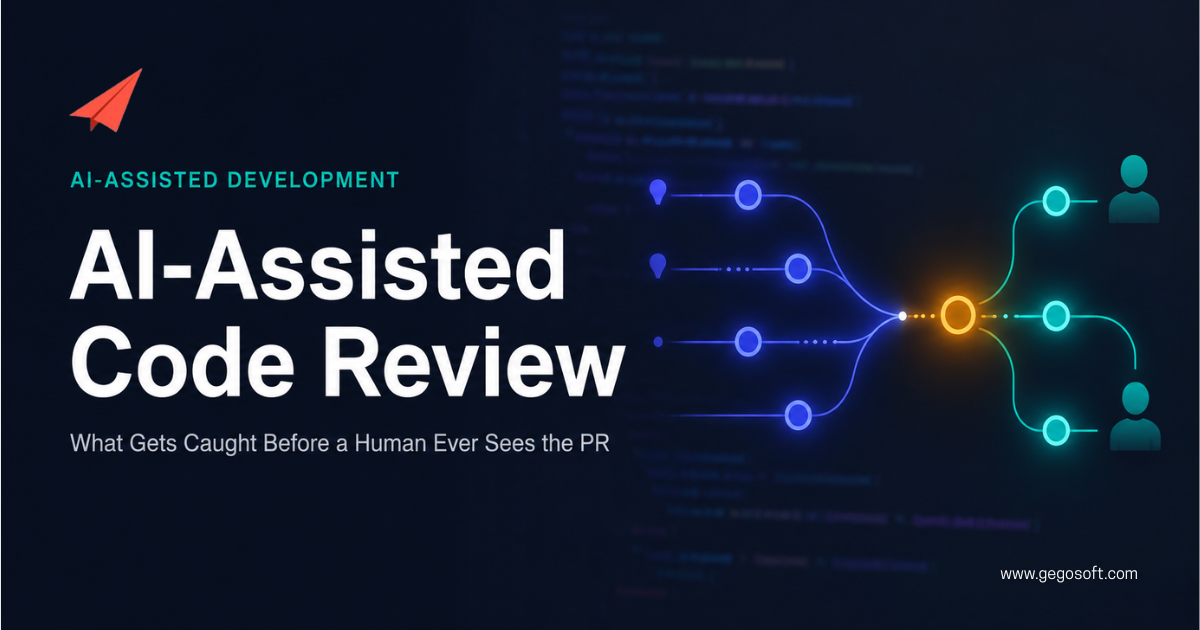
A linter has always been able to tell you a variable is unused. That’s not what we mean by AI-assisted code review. We mean something closer to a second engineer reading every pull request. It checks for security gaps. It checks for anti-patterns and performance problems. All of that happens before a senior developer ever opens the same file. That distinction matters, and it’s worth explaining honestly instead of just waving the word “AI” at it.
This is the second piece in our series on what a Claude Code development workflow actually looks like day to day. Last time, we walked through the full Plan, Build, Review, Ship cycle. This time we’re zooming into one stage specifically: review. If you’re weighing whether an AI-assisted development partner is worth the switch, this is often the part that matters most for shipping quality software on a deadline.
Why AI-Assisted Code Review Sits Before Human Review, Not Instead Of It
Here’s the ordering that makes this work. Every pull request goes through an automated review pass first. Only after that does a senior engineer look at it. That sequence isn’t an accident. Human attention is limited, and it’s expensive. Spending it on catching a missing null check for the fifth time this month is a poor use of anyone’s judgment.
Flip the order and the benefit disappears. If a human reviews first, they still have to slog through the boring stuff before reaching the judgment calls. Putting automated review first changes that. The boring stuff gets flagged immediately. It gets flagged consistently, without fatigue, every single time. The human reviewer then opens a pull request that’s already been through one filter. They can spend their attention on questions a machine genuinely can’t answer.
What This Review Stage Actually Catches
This is the part that’s easy to overstate or understate. So let’s be specific about what shows up in practice, day to day.
Security gaps
Unsanitized inputs. Missing authorization checks. SQL injection risks. Secrets accidentally left in a commit. These are exactly the issues that are easy to miss under deadline pressure. They’re also expensive to discover after launch, once real users are affected. An automated pass flags these consistently. It doesn’t matter how tired the engineer writing the code was that day.
Anti-patterns
Deeply nested conditionals. Duplicated logic that should be a shared function instead. N+1 query problems buried in Laravel Eloquent relationships. React components re-rendering more often than they need to. None of these break the build today. All of them make a codebase harder to maintain six months from now, which is exactly when nobody remembers why the code was written that way in the first place.
Performance issues
Unindexed database queries. Unnecessary API calls sitting inside a loop. Bloated bundle sizes caused by one unused import. These rarely show up during a quick manual read of a diff. Instead, they show up in production, usually as a support ticket complaining that a dashboard loads slowly.
Style and consistency
This one sounds minor, but it compounds fast. Eighteen engineers touch the same Laravel or NestJS codebases across different projects. Small style drift adds up over time. Eventually the codebase feels inconsistent to work in, even when every individual change looked fine on its own. Catching this automatically means nobody has to play “style police” in every single review.
What AI-Assisted Code Review Still Misses
We’d be doing you a disservice if we stopped there. There’s a lot this stage genuinely cannot do.
It doesn’t know whether a feature actually solves the client’s business problem. It doesn’t know a particular workaround exists because of a quirky legacy system three services away. It can’t weigh a real tradeoff, like shipping now with a documented limitation versus delaying a release to do something properly. That’s a judgment call, and it depends on context no automated pass has access to.
This is exactly why the human reviewer still exists, and always will. Their job changes under this workflow. It doesn’t shrink. If anything, it gets more focused. Architecture decisions. Business logic correctness. Whether the change actually solves the underlying problem, instead of just satisfying the ticket as it was written.
A Typical Example From Our Review Queue
Here’s a composite example, built from patterns we see often, without pointing at any specific client project. A pull request adds a new endpoint to an existing Laravel API. It’s meant to retrieve a user’s order history. The automated review pass flags three things right away. First, the endpoint has no rate limiting. Second, there’s a database query sitting inside a loop that should be one single query with eager loading instead. Third, there’s a missing authorization check. Without it, any authenticated user could query someone else’s orders just by changing an ID in the request.
None of those three issues are subtle once someone points them out. All three are exactly the kind that slip past a rushed manual review at the end of a sprint, when everyone just wants the ticket closed. The human reviewer, freed from having to spot all three independently, spends their time on something more valuable instead. They confirm the endpoint’s pagination approach actually matches how the frontend team plans to use it. That’s a conversation about product fit, not a bug hunt.
How This Changes What Human Reviewers Actually Do
The honest answer is that reviewing got harder, in a good way. When the obvious stuff gets caught automatically, the remaining review conversation has to be about substance. There’s nowhere to hide behind “well, at least I caught the typo.” Senior engineers on our team have told us review feels more engaging now, not less. The low-value parts of the job got automated away, and what’s left is the interesting part.
It also changed how quickly a pull request moves from opened to merged. Fewer back-and-forth cycles happen over small, mechanical issues. Those get caught, and often fixed, before a human reviewer even sees the diff. That leaves more back-and-forth over genuinely interesting design questions instead. Those questions tend to resolve faster too, once everyone’s attention isn’t split across a dozen minor nitpicks at the same time.
How We Rolled This Out Without Slowing the Team Down
Adopting this stage wasn’t instant, and it’s worth saying so plainly. The first few weeks involved tuning what the automated pass flagged, because an overly aggressive first version buried real issues under noise. We adjusted thresholds until the signal-to-noise ratio matched what a thoughtful senior engineer would actually flag, not what a strict linter would flag on principle. That tuning process took longer than we expected going in, and we’d rather admit that than pretend the rollout was seamless from day one.
We also made a deliberate choice to keep a human in the loop on every single pull request, with no exceptions. An automated pass approving code on its own, without a person confirming it, isn’t a workflow we’re willing to run. The efficiency gain comes from ordering, not from removing human judgment out of the process entirely.
That distinction gets asked about often, so it’s worth stating plainly. Nobody on our team merges code because an automated pass said it looked fine. A person always signs off. The automation changes what that person spends their time looking at. It never changes who’s accountable for what ships.
Where This Fits Into How We Work With Clients
An AI-assisted code review pass isn’t a feature we sell on its own. It’s one piece of the broader software development services we deliver — Laravel builds, React and Next.js frontends, NestJS backends, and the payment and API integrations that come with all of them. Clients notice the outcome more than the process. That usually means fewer post-launch bug reports, and a codebase that’s easier for our team, or theirs, to pick back up months later.
If you’d like to see the kind of production work this review process supports, our portfolio covers admin panels, dashboards, and integration-heavy builds across the industries we work in regularly. You can also read more about how our team operates day to day before deciding whether an AI-assisted partner is the right fit for your next project.
The Honest Takeaway
This kind of review isn’t a replacement for a good senior engineer. Anyone telling you otherwise is overselling it. What it actually does is remove the tedious, easy-to-miss layer of review work. That frees the human reviewer to spend attention where it belongs: on judgment, on architecture, and on whether the code genuinely solves the right problem. That’s a meaningfully better use of everyone’s time, and it shows up directly in the software you receive.
If you’re evaluating a development partner and want to know exactly how review works on your project before committing to anything, request a free quote and ask us directly. We’re happy to walk through it in detail.