
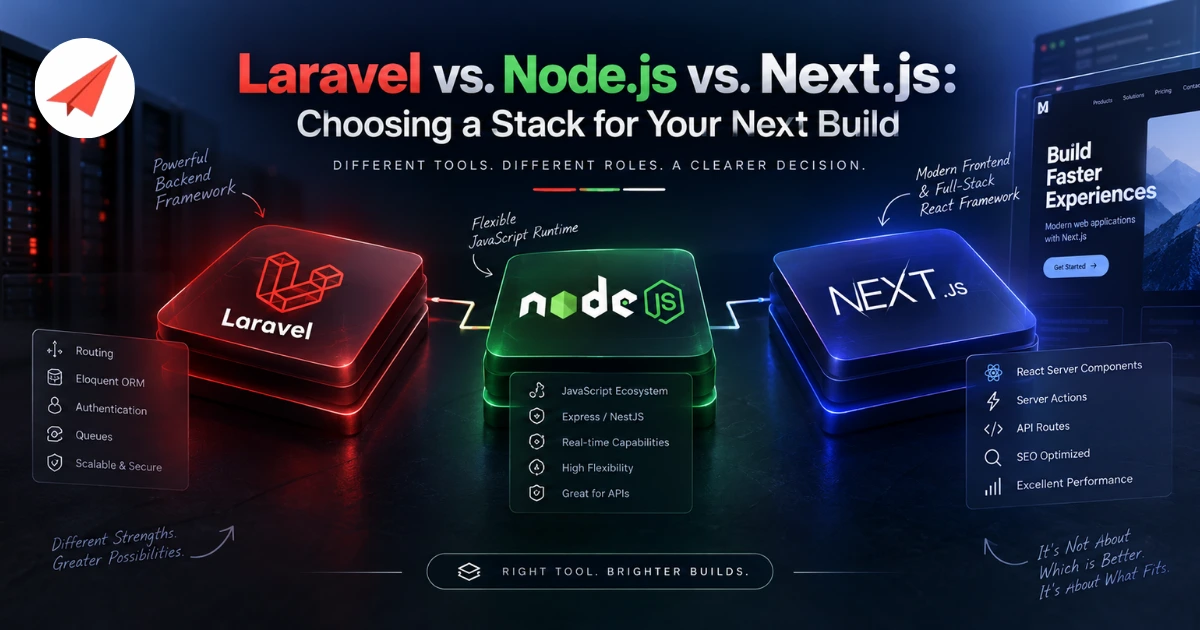
This comparison gets asked about constantly. It usually gets answered badly, because it treats three tools as if they compete in the same category. Laravel vs Node.js is a genuine backend comparison. Next.js isn’t really in that same conversation at all. It’s a frontend and full-stack React framework that often sits on top of a backend, sometimes even a Laravel one. Getting that distinction right changes the whole decision.
Here’s how we actually think through this choice on a real project. We’ll start with the comparison that’s genuinely apples to apples.
What Each One Actually Is
Laravel is a full backend framework for PHP. It handles routing, a database layer through Eloquent, authentication, queues, and most of what a typical server-side application needs. All of it gets built around a single, opinionated set of conventions.
Node.js isn’t a framework at all. It’s a JavaScript runtime. It lets JavaScript run on a server instead of only in a browser. Comparing it directly to Laravel is a little imprecise. Most real “Node.js” backends are actually built with a framework running on top of Node, commonly Express or NestJS. We’ve written about that choice separately in an earlier piece on when NestJS earns its added structure.
Next.js is a React framework, built by Vercel, focused on the frontend and increasingly on full-stack rendering patterns. Its App Router uses React Server Components by default. That lets a component fetch data directly on the server and stream the result to the browser, without a separate client-side data-fetching step. It can also handle server-side logic directly through Server Actions and API routes. That’s exactly where the comparison to Laravel and Node.js gets genuinely confusing for a lot of teams.
The Real Comparison: Laravel vs Node.js as a Backend
This is the comparison that’s actually fair, since both are legitimate full backend choices for the same kind of application. Laravel’s biggest advantage is convention. Routing, validation, database access, authentication, and queues all follow one coherent set of patterns. Everything gets documented consistently across the entire framework. A developer moving between two different Laravel projects finds a similar structure in both. That matters enormously for onboarding speed on outsourcing engagements specifically.
A Node.js backend, especially one built with a minimal framework like Express, offers more flexibility. It also shares a language with a JavaScript frontend. That shared language matters if a team wants the same engineers comfortable working across both the frontend and backend, without context-switching between PHP and JavaScript. The tradeoff is less built-in structure. A team either adopts a framework like NestJS to get comparable conventions, or builds its own patterns from scratch. The second path carries real consistency risk across a growing team.
Where Next.js Fits: Frontend Framework, Not a Backend Replacement
Next.js solves a different problem than either Laravel or a Node.js backend does. Its core strength is rendering React efficiently. Server Components reduce the JavaScript sent to a browser. Server Actions handle form submissions and mutations without a separate API layer to maintain. For a content-heavy site, a marketing page, or an application where rendering performance directly affects user experience, Next.js is a genuinely strong choice. That holds regardless of what powers the backend behind it.
The confusion shows up when Next.js’s Server Actions and API routes tempt a team into treating it as a full backend replacement too. That works fine for simple cases. It gets uncomfortable fast for an application with serious backend needs. Complex business logic, background job processing, and a data model that outgrows what fits comfortably inside a frontend framework’s server-side conveniences all push in that direction. At that point, Next.js works best as a frontend layer talking to a real backend. That backend might be Laravel, a Node.js API, or something else entirely.
When to Pair Next.js With Laravel vs a Node Backend
A Next.js frontend paired with a Laravel API makes sense when a project’s backend logic is genuinely complex. Laravel’s conventions and mature ecosystem offer real value there. The frontend still benefits from React’s component model and Next.js’s rendering performance on top of it. We build this combination regularly for clients who want a highly polished frontend experience without giving up Laravel’s backend strengths.
A Next.js frontend paired with a Node.js or NestJS backend makes more sense in different circumstances. A team wanting a single language across the entire stack fits that pattern well. So does a backend that benefits from Node’s ecosystem, real-time capabilities, or a team already deeply familiar with the JavaScript ecosystem end to end. Neither pairing is universally better. Both are legitimate answers to different constraints.
A Realistic Decision Framework
A few concrete questions cut through this faster than a general framework preference. Does the project need a separate, reusable API that might serve more than one frontend? A web app and a mobile app sharing one backend is a common example. If so, a dedicated Laravel or Node backend, decoupled from whatever renders the frontend, tends to make more sense. Leaning on Next.js’s built-in server features alone usually isn’t enough at that scale.
Does the team already have deep expertise in one ecosystem specifically? A team of strong Laravel developers building a Node backend from scratch, purely to match a trend, usually delivers worse results than staying in their strongest ecosystem. Pairing that ecosystem thoughtfully with Next.js on the frontend often beats forcing an unfamiliar stack everywhere. Does rendering performance and SEO genuinely matter for this specific project? If so, Next.js earns its place as the frontend layer regardless of which backend sits behind it, since that’s the problem it solves best.
A Question We Get Asked Often: Does Next.js Ever Fully Replace a Backend?
Sometimes, and it’s worth being specific about when. A small application with modest data needs, simple authentication, and no requirement to serve a separate mobile client can genuinely run its entire backend logic through Next.js’s Server Actions and route handlers. A marketing site with a contact form, a simple content platform, or an internal tool with light data needs often fits comfortably inside that model without needing Laravel or a Node API at all.
The signal that a project has outgrown that model is usually background processing. The moment a task needs to run outside the request-response cycle, a scheduled report, an email queue, a webhook handler that needs retry logic, Next.js’s server-side conveniences start feeling like the wrong tool for the job. That’s the point where pulling in a real backend, rather than stretching Next.js further, tends to save more time than it costs.
A Realistic Example
Consider a SaaS product with a genuinely complex backend, handling multi-tenant billing, background report generation, and a large relational data model. Pairing a Laravel backend with a Next.js frontend fits this well. Laravel handles the complex domain logic with its mature queue system and Eloquent ORM. Next.js renders a fast, SEO-friendly marketing site and a responsive dashboard on top of that same API, using Server Components to keep the client-side JavaScript bundle small.
Now consider a real-time collaborative tool, where WebSocket connections and live data sync are the application’s core feature. A Node.js or NestJS backend, built specifically around real-time event handling, tends to fit that use case more naturally than routing everything through a request-response API layer designed primarily for typical CRUD operations.
Where This Fits Into How We Work With Clients
We don’t default to one combination across every project. Our software development services include Laravel backends, Node and NestJS backends, and Next.js frontends, paired according to a specific project’s actual needs rather than whichever stack happens to be trending. The same honest reasoning applies here that we use when choosing TALL stack development over a separate frontend elsewhere in our work: the project’s shape drives the decision, not a general framework preference.
You can see examples of the stack combinations we’ve built in our portfolio, and read more about how our team approaches these decisions before committing to a stack for your own project.
The Honest Takeaway
Laravel vs Node.js is a real, fair comparison between two legitimate backend choices. The right answer depends on team expertise, need for structure, and language preference across a stack. Next.js isn’t really competing in that same conversation. It’s a frontend and rendering layer that can pair well with either backend, or occasionally handle simple backend needs on its own. Understanding which category each tool actually belongs to is worth more than picking a single winner among all three at once.
If you’re weighing this decision for your own project, request a free quote and we’ll walk through which combination actually fits your specific needs.