
India’s eCommerce market crossed $100 billion in gross merchandise value in 2024 and continues expanding as D2C brands bypass traditional retail, manufacturers open direct storefronts, and service businesses add product lines to diversify revenue. The opportunity is real and well-documented. What is less discussed is how many of the online stores built to capture that opportunity underperform — not because the market rejected them, but because they were built without the technical and conversion discipline that turns visitors into customers.
A slow-loading product page costs sales before a single review or price comparison happens. A checkout flow with too many steps abandons carts that were already committed to purchase. A store with no mobile optimisation loses the majority of Indian shoppers before they see the second product. These are not marketing problems. They are development problems — and they are entirely preventable with the right technical partner.
This page is for businesses ready to build or rebuild an eCommerce platform in India — covering what to build it on, what it should cost, and what GegoSoft Technologies delivers.
GegoSoft Technologies: eCommerce Development From Madurai, Tamil Nadu, India
GegoSoft Technologies (OPC) Private Limited is a software development company headquartered in Madurai, Tamil Nadu, India — operating since 2016 and delivering web applications, mobile apps, and eCommerce platforms for clients across India and internationally.
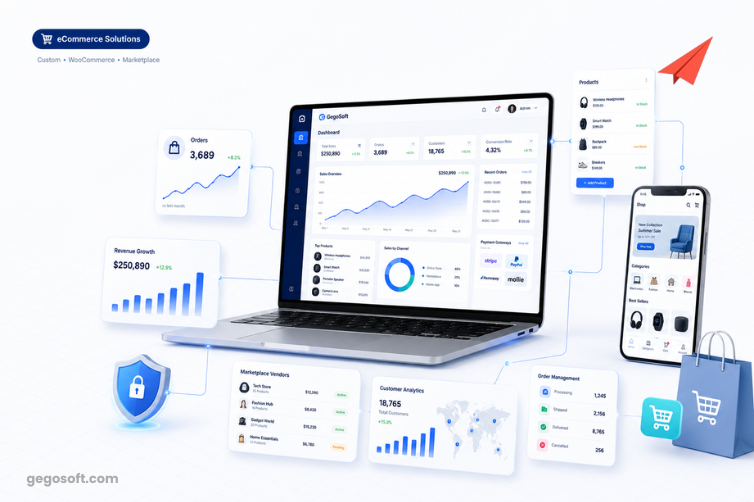
GegoSoft’s eCommerce capability spans two distinct paths: WooCommerce development for businesses building on WordPress’s open-source eCommerce foundation, and custom multi-vendor marketplace development through GegoCart — the company’s own production marketplace platform — for businesses building Amazon or Flipkart-style multi-seller experiences.
Recognition: SoftwareSuggest Top Web Development Company 2025 · Best UX Company 2023
Choosing the Right eCommerce Architecture: WooCommerce vs. Custom Platform vs. Multi-Vendor Marketplace
The first decision in any eCommerce project — and the one most likely to be made incorrectly without proper guidance — is which underlying architecture to build on. Each path serves a different business model.
WooCommerce: The Right Choice for Single-Seller Stores
WooCommerce powers over 28% of the world’s top online stores. Built on WordPress, it offers full code ownership, zero platform transaction fees, native support for Indian payment gateways (Razorpay, Paytm, PayU, CCAvenue), and an enormous plugin ecosystem for extending functionality.
WooCommerce is the right architecture when:
- A single business is selling its own products or services
- The product catalogue is moderate in size (hundreds to low thousands of SKUs)
- Content marketing and blog integration alongside the store matters
- Long-term cost efficiency (no per-transaction platform fee) is a priority
Custom Platform: The Right Choice for Unique Business Logic
A fully custom eCommerce build is justified when business requirements exceed what WooCommerce’s plugin ecosystem handles cleanly — complex pricing rules (tiered B2B pricing, negotiated contracts, region-specific catalogues), unusual fulfilment logic, or deep integration with existing ERP and inventory systems that off-the-shelf plugins cannot bridge without significant custom development anyway.
Multi-Vendor Marketplace: The Right Choice for Multiple Sellers
When the business model involves multiple independent sellers offering products through a single platform — the Amazon or Flipkart model at a smaller scale — a dedicated multi-vendor marketplace architecture is required. This involves vendor onboarding and verification, vendor-specific dashboards, commission calculation and payout management, and order routing logic that a standard single-seller WooCommerce store does not handle natively (though multi-vendor plugins exist with varying degrees of reliability at scale).
GegoSoft’s GegoCart platform is purpose-built for this model — a production multi-vendor marketplace system that handles vendor management, commission structures, and order fulfilment at the architectural level rather than as a bolted-on plugin.
What GegoSoft Builds: eCommerce Services in Detail
WooCommerce Store Development
Custom-coded WooCommerce themes — not pre-built templates reskinned with a logo change — built for speed and conversion from the first line of code. Indian payment gateway integration (Razorpay, Paytm, PayU) with proper webhook handling for order status synchronisation. GST-compliant invoice generation with correct HSN code mapping and tax calculation. Product page design optimised for the mobile-first reality of Indian shoppers, where the majority of eCommerce traffic originates from smartphones.
Full WooCommerce development details →
Multi-Vendor Marketplace Development
Vendor registration and KYC verification workflows. Individual vendor dashboards for inventory, order, and payout management. Commission structure configuration — flat rate, category-based, or vendor-tier based. Order splitting logic when a single customer order includes products from multiple vendors. Vendor rating and review systems. Dispute resolution tools for order issues between buyers and vendors.
GegoSoft’s GegoCart provides this architecture as a foundation that can be deployed and customised, significantly reducing the development timeline compared to building multi-vendor logic entirely from scratch.
Store Migration
Full data migration from Shopify, Magento, OpenCart, PrestaShop, or custom-built stores to WooCommerce or a custom platform — including product catalogues, customer accounts, order history, and critically, SEO URL structure preservation with proper 301 redirects so existing search rankings are not lost in the transition.
Performance Optimisation for Existing Stores
For businesses with an underperforming existing store rather than a new build, GegoSoft conducts performance audits targeting the specific factors that suppress conversion: page load speed, image optimisation, database query efficiency, checkout flow friction points, and mobile usability issues. A 1-second delay in page load time reduces conversions by approximately 7% according to Akamai research — for a store generating meaningful revenue, that translates directly into lost sales every month a performance issue goes unaddressed.
Payment Gateway and Logistics Integration
Beyond the primary payment gateway, eCommerce stores require integration with shipping and logistics providers (Delhivery, Shiprocket, India Post), SMS and WhatsApp order notifications, and in many cases, marketplace integrations (selling simultaneously through your own store and through Amazon or Flipkart with synchronised inventory).
eCommerce Performance Standards GegoSoft Builds To
| Metric | Industry Average | GegoSoft Target |
|---|---|---|
| Google PageSpeed Score | 35–55 | 90+ |
| Page Load Time | 4–8 seconds | Under 2.5 seconds |
| Largest Contentful Paint (LCP) | 4+ seconds | Under 2.5 seconds — Core Web Vitals passing |
| Mobile Responsiveness | Often an afterthought | Mobile-first by design |
| Checkout Steps | 4–6 steps common | Optimised to minimum necessary steps |
These are not aspirational figures — they are the baseline standard applied to every eCommerce build, because each of these metrics has a direct, measurable relationship with conversion rate and search ranking.
eCommerce SEO: Built Into the Store, Not Added Afterward
Traffic without conversion is wasted spend. Conversion without traffic is invisible. GegoSoft integrates SEO architecture into every eCommerce build from the first development sprint:
- Clean URL structure for product, category, and collection pages — optimised for target keywords from the outset
- Product schema markup showing price, availability, and review ratings as rich results in Google search
- Site speed engineering to meet Core Web Vitals thresholds, which Google uses as a ranking signal
- Internal linking architecture connecting category pages, product pages, and content to distribute search authority across the store
- Google Shopping feed configuration for Merchant Centre integration and Shopping ad campaigns
- Structured meta data — automated, customisable meta titles and descriptions for every product and category page
After launch, GegoSoft’s digital marketing service can drive ongoing organic and paid traffic growth — search optimisation, Google Ads, and conversion rate testing to keep the store growing month over month.
eCommerce Development Pricing in India
GegoSoft provides fixed-price quotations after understanding your specific catalogue size, functionality requirements, and integration needs. The ranges below are indicative.
| Project Type | What’s Included | Indicative Range | Timeline |
|---|---|---|---|
| WooCommerce Starter Store | Custom theme, up to 100 products, payment gateway, basic SEO | ₹25,000 – ₹50,000 | 4–6 weeks |
| WooCommerce Growth Store | Custom theme, up to 1,000 products, advanced SEO, CRM integration | ₹50,000 – ₹1,50,000 | 6–10 weeks |
| Custom eCommerce Platform | Bespoke architecture, custom pricing logic, ERP integration | ₹8 – ₹40 lakhs | 14–28 weeks |
| Multi-Vendor Marketplace | Vendor dashboards, commission engine, order splitting | ₹15 – ₹60 lakhs | 16–32 weeks |
| Store Migration | Platform-to-platform migration with SEO preservation | ₹40,000 – ₹3,00,000 | 4–10 weeks |
| Performance Optimisation (existing store) | Speed audit and remediation, Core Web Vitals compliance | ₹25,000 – ₹80,000 | 2–5 weeks |
All engagements include milestone-based payment schedules and 100% source code ownership on delivery.
GegoSoft’s eCommerce Development Process
Phase 1 — Discovery and Strategy Product catalogue structure, target audience, logistics model, payment preferences, and growth goals mapped to define the right architecture — WooCommerce, custom, or multi-vendor — before any design work begins.
Phase 2 — UX and UI Design Custom wireframes and design mockups for desktop and mobile, reviewed and approved before development. Conversion-focused layouts with clear purchase flows, trust signals (reviews, security badges, return policy visibility), and minimal-friction checkout design.
Phase 3 — Development Custom theme or platform built to the approved design. Payment gateways, shipping logistics, and inventory systems integrated and tested. Custom functionality developed where the use case requires it.
Phase 4 — Product Catalogue Setup Full product catalogue uploaded with optimised titles, descriptions, images, categories, and attributes. Bulk import tooling for large catalogues to avoid manual entry bottlenecks.
Phase 5 — Performance and Security Hardening Page speed optimisation pass, SSL configuration, firewall setup, brute-force protection, and automated backup scheduling — completed before launch, not retrofitted after a security incident.
Phase 6 — Launch and Post-Launch Monitoring Pre-launch checklist review, staged-to-live deployment, Google Analytics and Search Console configuration, and active monitoring through the first 30 days of live operation when traffic and order patterns reveal issues that testing cannot always anticipate.
Comparing eCommerce Development Approaches
| Factor | WooCommerce (GegoSoft) | Shopify | Custom Platform |
|---|---|---|---|
| Platform fees | None — open source | Monthly subscription + transaction fees | None |
| Code ownership | Full | Platform-controlled | Full |
| Indian payment gateways | Native (Razorpay, Paytm, PayU) | Limited native options | Built to specification |
| GST compliance | Native plugin support | Requires custom configuration | Built to specification |
| Customisation ceiling | High | Limited to Shopify’s ecosystem | Unlimited |
| Best for | Single-seller stores of any size | Quick launch, lower technical complexity | Unique business logic, multi-vendor, ERP integration |
Frequently Asked Questions
Q: Should I build my eCommerce store on WooCommerce or a custom platform?
A: WooCommerce is the right choice for the large majority of single-seller eCommerce businesses — it offers full code ownership, no transaction fees, and a mature plugin ecosystem for standard functionality. A custom platform is justified when business logic exceeds what WooCommerce’s plugins handle cleanly — complex B2B pricing tiers, deep ERP integration, or highly specific fulfilment workflows. GegoSoft recommends the right architecture after understanding your specific requirements during a free consultation, rather than defaulting to whichever option is easier to sell.
Q: How long does it take to build an eCommerce store in India?
A: A WooCommerce store with a custom theme and up to a few hundred products typically takes four to ten weeks depending on complexity. A custom eCommerce platform with bespoke functionality takes fourteen to twenty-eight weeks. A multi-vendor marketplace with vendor dashboards and commission management takes sixteen to thirty-two weeks. Timeline is primarily driven by functionality scope and catalogue complexity rather than by development speed.
Q: Can GegoSoft migrate my existing store to a new platform without losing search rankings?
A: Yes. Store migration includes URL structure mapping and 301 redirects from old URLs to new ones, preserving the SEO equity an existing store has built. Product data, customer accounts, and order history are migrated alongside the technical SEO elements. Post-migration monitoring confirms search rankings remain stable rather than dropping due to broken redirects or lost metadata.
Q: What is a multi-vendor marketplace and do I need one?
A: A multi-vendor marketplace allows multiple independent sellers to list and sell products through a single platform, with the platform operator earning commission on sales — the Amazon or Flipkart model at a smaller scale. You need this architecture specifically if your business model involves onboarding other sellers rather than just selling your own products. If you are a single brand selling your own catalogue, a standard WooCommerce or custom single-seller store is the more appropriate and significantly less complex architecture.
Q: Does GegoSoft handle ongoing eCommerce store maintenance after launch?
A: Yes. Post-launch support is included with every eCommerce engagement, and ongoing maintenance retainers are available covering security updates, plugin management, performance monitoring, and minor feature additions. Because the same development team that built the store provides ongoing support, there is no knowledge transfer delay when issues need to be resolved.
Q: How does GegoSoft ensure my eCommerce store loads quickly for Indian mobile users?
A: Performance optimisation is built into the development process rather than addressed after launch — image compression and WebP conversion, server-side caching configuration, database query optimisation, minimal and audited plugin usage, CDN integration, and CSS/JavaScript minification. Every store is tested on real mid-range Android devices on throttled connections to validate performance under the conditions most Indian shoppers actually experience, not just on a developer’s high-speed office connection.
Your Store Should Work as Hard as Your Best Salesperson
An eCommerce platform is not a digital catalogue. It is a sales engine that operates continuously, a customer service touchpoint, and increasingly the primary way customers form their first impression of a brand. Built with the right architecture, the right performance discipline, and the right conversion-focused design, it compounds in value as traffic grows. Built poorly, it actively works against the marketing investment driving traffic to it.
GegoSoft Technologies, based in Madurai, Tamil Nadu, India, brings the full stack an eCommerce business needs — WooCommerce expertise, custom platform development, multi-vendor marketplace architecture through GegoCart, performance engineering, and the digital marketing capability to drive traffic once the store is built to convert it.
Book a free eCommerce consultation →
Related services: WooCommerce Development · GegoCart Multi-Vendor Marketplace · WordPress Development · Responsive Web Design · Digital Marketing · Laravel Development