
The pharmacy counter is where clinical meets commercial
A multi-location pharmacy platform handling prescription review, dispensing, POS, inventory, purchasing and supplier management — one side answerable to a prescriber, the other to an auditor.
Built with SmartDocx AI Systems Private Limited, a healthcare technology venture co-founded by GegoSoft's founder.
- SECTOR
- Pharmacy retail
- SCOPE
- Multi-location chain
- TEAM
- 4 members
- ARCHITECTURE
- Microservices
- STATUS
- Private Beta
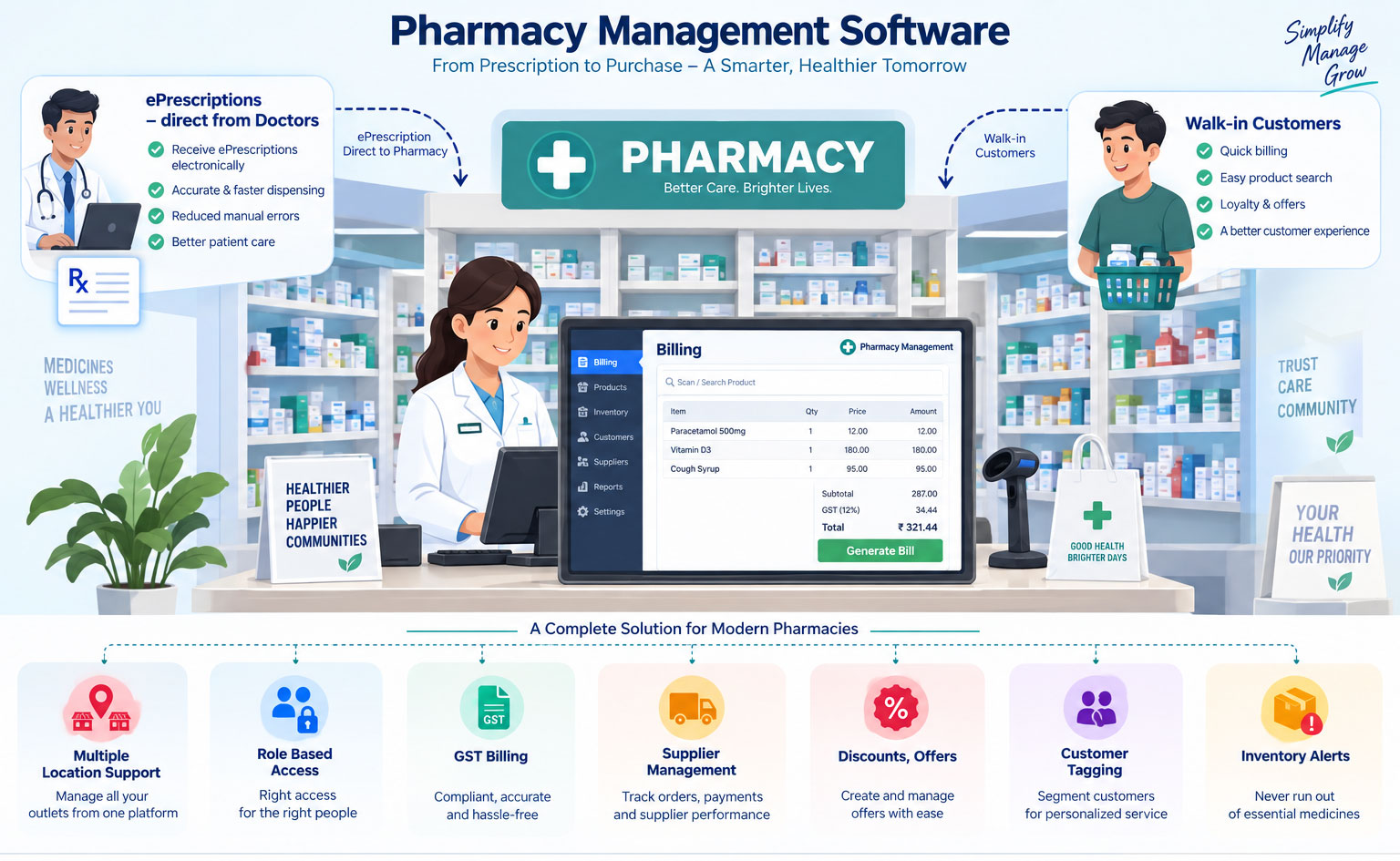
Two systems meeting at one counter
A pharmacy looks like retail. It has a till, stock, suppliers and margins. But what crosses the counter arrived from a clinical decision and carries clinical consequences, and the record it leaves behind has to satisfy two very different kinds of scrutiny.
Answerable to the prescriber
- Which prescription this dispensing satisfies
- Whether the medicine matches what was prescribed
- Dose, frequency, duration and instructions as written
- Which patient, on whose authority, from which ward
- Substitutions, and whether they were permitted
Answerable to an auditor
- Batch and expiry of the exact units dispensed
- Which supplier, at what cost, on which purchase order
- Tax treatment and pricing at the point of sale
- Stock movement between branches
- Reconciliation between recorded and physical stock
Most pharmacy software is a retail system that learned about medicines. We built from the prescription outward instead.
Because the pharmacy shares its architecture with the LifeBridge hospital and EMR platforms, a prescription raised during a consultation appears at the counter as structured data. No re-keying, no interpreting handwriting, and the dispensing record links back to the clinical decision that produced it.
What multi-location actually demands
Running several branches is not running one branch several times. The constraints only appear at the second location.
Stock is local, visibility is central
Each branch bills from its own physical stock, but head office needs one view across all of them to move slow inventory before it expires.
Purchasing is negotiated centrally
Supplier terms and pricing are agreed once and applied everywhere. A branch should not be able to quietly buy outside the agreement.
Expiry is a chain-wide problem
Stock expiring at one branch may be in demand at another. Without cross-branch visibility that is written off rather than transferred.
Reorder levels differ by branch
A branch beside a dialysis unit has a different demand profile from a high-street outlet. One chain-wide reorder level is wrong for both.
Billing must not stop
The counter has to keep working during network problems. A patient waiting for medication is not a good moment to discover the system needs connectivity.
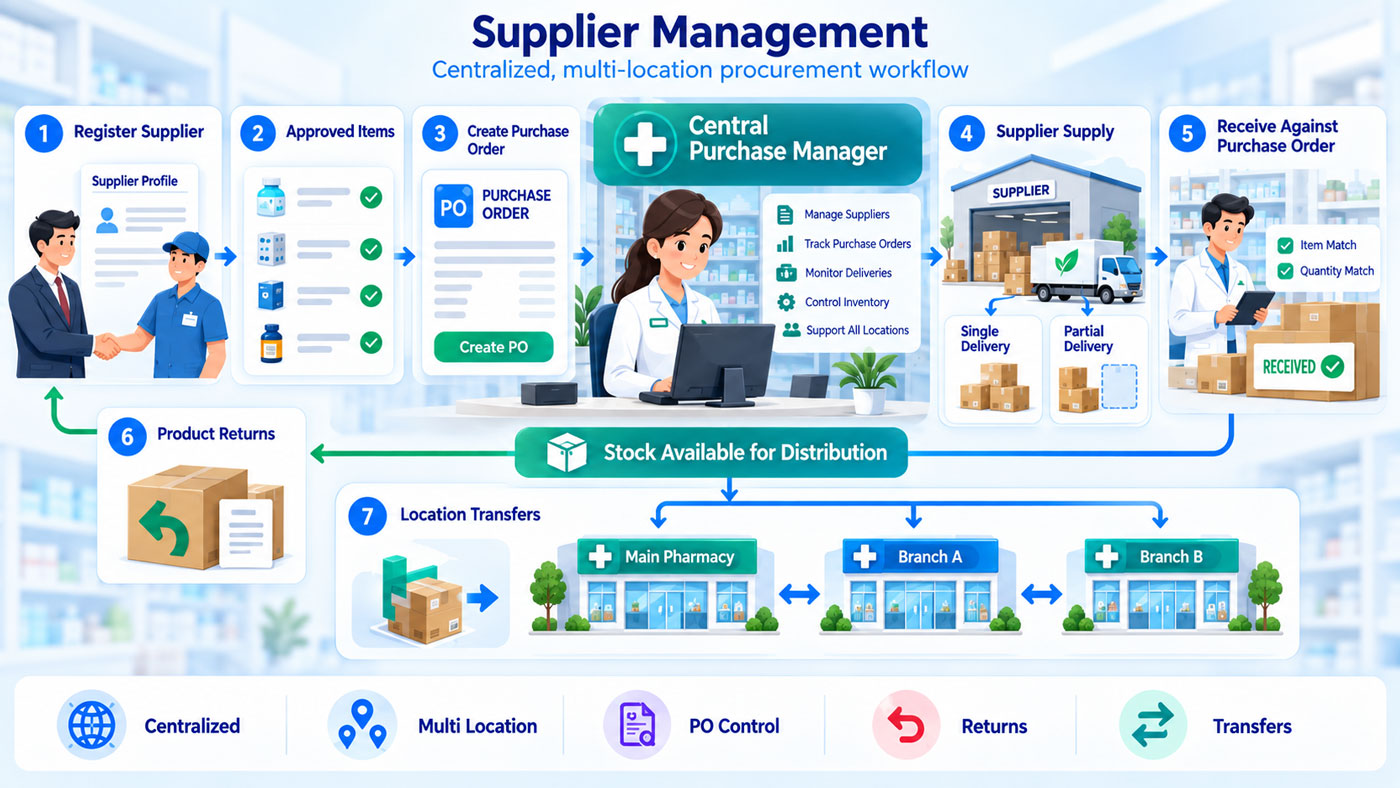
What the platform covers
Technology choices and why
Shared foundations with the other LifeBridge platforms, because the pharmacy's most valuable input comes from the clinical system next door.
NestJS microservices
Billing must stay responsive while purchasing, reporting and alerting run in the background. Separate services keep an overnight job away from the counter.
MongoDB
Product records vary widely across manufacturers, pack sizes and formulations. A document model handles that without a schema change per supplier catalogue.
Next.js
The same application serves fast counter billing and dense head-office inventory screens.
Shared platform services
Prescriptions arrive from the hospital and EMR platforms as structured data rather than through an integration layer built after the fact.
Refill reminders on the channel customers read, which matters most for long-term medication adherence.
Claude
Operational assistance and report generation over inventory and purchasing data, not clinical decision-making.
How the team built it
A four-person team. GegoSoft engineers use Claude Code as standard daily tooling, and here the concentration was on the parts where correctness is arithmetic: tax calculation, batch allocation, stock reconciliation and margin computation. Exhaustive test cases against those rules are exactly what gets cut when a deadline approaches, and exactly what should not be.
The prescription-first data model and the branch and permission structure were the team's design. Every change passed normal review before merge.
Where it stands
The pharmacy platform runs alongside the LifeBridge EMR, hospital management and AI agent products on shared service architecture.
Common questions
Can GegoSoft build pharmacy software for our chain?
Yes. We can build from scratch or adapt the LifeBridge pharmacy platform. The main variables are how many branches you run, whether you need hospital or clinic integration, and what your current stock data looks like.
Does it work for a single pharmacy?
Yes, though the platform's strengths — cross-branch stock visibility, central purchasing, inter-branch transfers — matter most from the second location onward. We would say so before you bought it.
Does it handle batch and expiry tracking?
Yes. Stock is tracked at batch level with expiry dates, and alerts fire ahead of expiry so units can be transferred or prioritised rather than written off.
Can it connect to our hospital or clinic system?
It connects natively to the LifeBridge platforms, where prescriptions arrive as structured data. Integration with a third-party system depends on what that system exposes, which we assess before scoping.
Does it handle GST and Indian tax requirements?
EDIT-ANSWER — confirm current GST handling, HSN code support and invoice format compliance before publishing. This is the first question an Indian pharmacy buyer will ask, so the answer needs to be exact.
Running pharmacies on separate systems?
Tell us how many branches you run and how stock moves between them today. Expiry write-offs and stock visibility are usually where the money is, and that is where we would look first.
Start a conversation See all case studies