
Feedback that reaches someone while it still matters
A patient feedback system for a hospital's quality management process — branching questionnaire, Tamil and English, QR and WhatsApp access, and a submission that notifies the responsible person the moment it arrives.
- SECTOR
- Hospital quality management
- ACCESS
- Public URL, QR, WhatsApp
- LANGUAGES
- Tamil and English
- STACK
- NextJS, MongoDB, ExpressJS
- STATUS
- Production, Live
Most feedback systems collect. This one had to deliver.
Paper forms and generic survey tools both fail hospitals the same way. They gather responses competently and then hold them until someone runs a report. By the time a complaint about a specific department on a specific afternoon reaches the person responsible for it, weeks have passed, the shift has changed, and nobody can reconstruct what happened.
That delay is not an inconvenience. It converts feedback from something actionable into something historical.
Feedback that arrives late is data. Feedback that arrives now is an intervention.
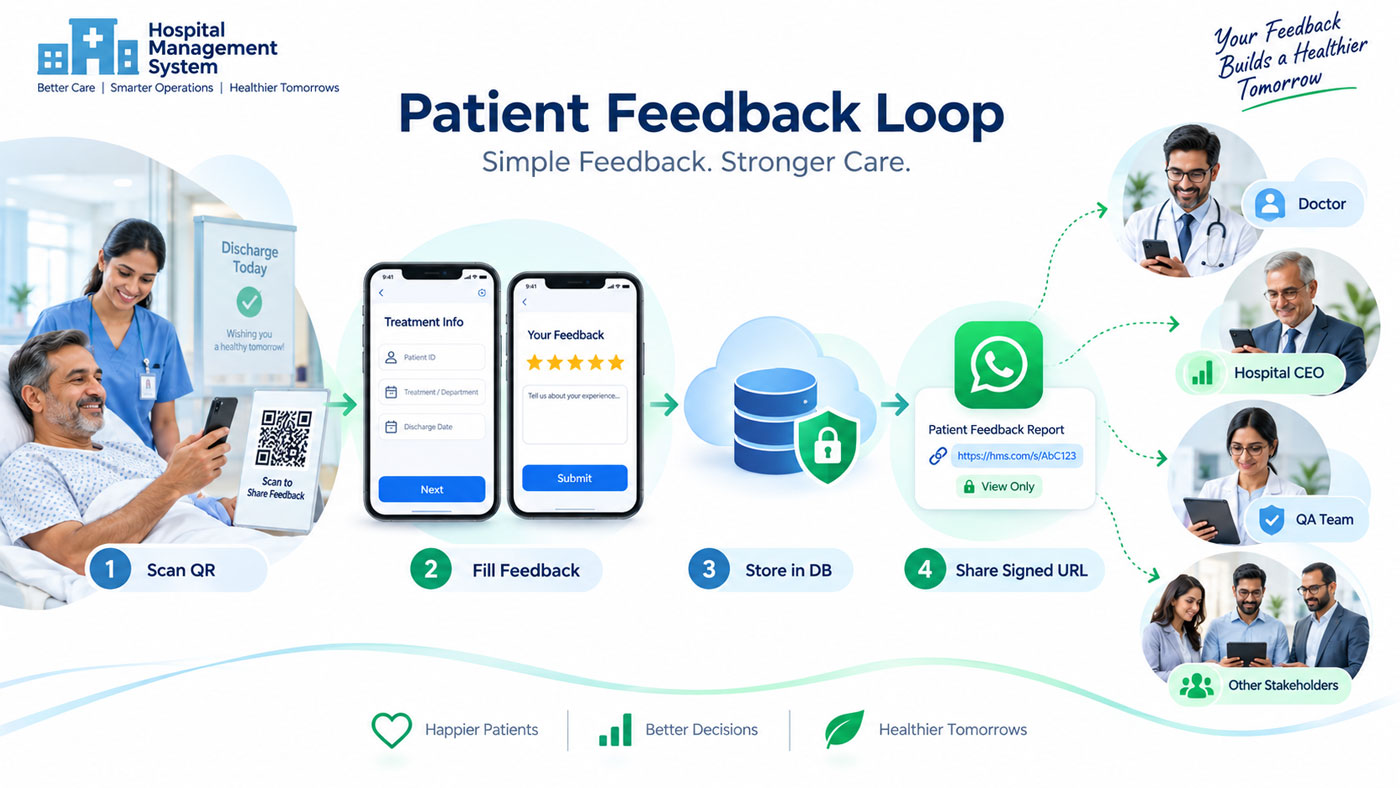
So the system was built around delivery rather than collection. A submission is stored, and in the same moment the responsible personnel receive a WhatsApp notification with access to that specific response. Nobody has to remember to check anything.
What happens when a patient presses submit
Response stored
The complete submission is written as structured data, including which branch of the questionnaire the patient was taken through.
Personnel notified
A WhatsApp notification goes to the staff responsible for reviewing feedback — not to a shared inbox nobody owns.
Access to the specific submission
The notification carries a link to that response rather than a summary count, so the reviewer sees exactly what the patient said.
Reviewed while it is current
Authorised staff open and act on it the same day. For a service issue, that is the difference between a correction and a pattern.
The form is only as long as the patient needs it to be
A linear questionnaire asks everyone everything. A patient whose visit went well is taken through eight questions about what went wrong, and a patient with a genuine complaint reaches the free-text box on question twenty-two, by which point many have abandoned the form.
The questionnaire engine branches instead. A yes or no answer determines what appears next, follow-up questions surface only where a response warrants them, and irrelevant sections are skipped rather than displayed and left blank.
For a patient who had a straightforward visit, that is a short form. For a patient who has something to say, the system asks more precisely — which is the only way to get detail worth acting on. Completion rate is the metric a feedback system lives or dies by, and length is the main thing that kills it.
Conditional paths
Responses determine which questions appear next, so the questionnaire adapts to the visit rather than assuming a standard one.
Rating scales where measurement matters
Service-quality dimensions use a one-to-ten scale, producing comparable numbers across overall experience, staff behaviour, waiting time, communication, facilities and likelihood to recommend.
Structured, not free text
Most answers are structured so responses aggregate into trends. Free text is reserved for where a patient genuinely needs to explain something.
The path is part of the record
Which branch a patient took is stored with the response, so a reviewer knows what was and was not asked.
Two ways in, two kinds of answer
QR codes and WhatsApp are not two delivery channels for the same thing. They catch patients in different states, and the hospital gets different feedback from each.
Immediate and specific
- Scanned at the touchpoint, minutes after the experience
- Detail is sharp — a name, a wait, a moment
- Emotion is high, both directions
- Catches patients who will not respond later
- No link to send, no number needed
Considered and complete
- Sent after the visit, answered at home
- Covers the whole visit rather than one moment
- Reflective rather than reactive
- Reaches patients who left without noticing a QR code
- Read reliably — email largely is not
Tamil is a data quality decision
Offering the questionnaire in Tamil as well as English is usually filed under accessibility. That undersells it. A patient answering in a second language does not simply find the form harder — they give shorter, blander, less specific answers, because articulating a complaint precisely is difficult in a language you are not fluent in.
The hospital was not short of responses. It needed responses with enough detail to act on. Letting a patient describe what happened in the language they think in changes the content of the feedback, not just the completion rate.
Feedback as audit evidence, not marketing
This system exists to serve a quality management process, which changes what it has to be good at. Marketing feedback wants volume and a favourable average. Quality management wants consistency, traceability and a record that stands up to review.
So responses are stored structurally, the questionnaire path is recorded alongside the answers, and every submission remains individually retrievable rather than being absorbed into a score. A reviewer can produce the specific response behind a specific finding, which is what an audit trail actually means.
What the system does
Design decisions
A focused application rather than a module of a hospital system — deliberately, because it had to be reachable by patients who have no account and no app.
No login, no app
Any barrier between a patient and a feedback form loses most of the responses. A public URL reached by QR or WhatsApp link was the only viable route.
Questionnaire as configuration
Branching rules are defined as data rather than hard-coded, so the hospital can revise its questionnaire as its quality process evolves.
Push, not pull
Notification on submission rather than a report someone remembers to open. The system's value is in the delay it removes.
Standalone, not an ERP module
Building this inside a hospital information system would have coupled a public-facing form to an internal clinical platform for no benefit.
How the team built it
GegoSoft engineers use Claude Code as standard daily tooling. The branching engine was where it mattered here — conditional questionnaire logic has a large number of paths, and testing that every combination of answers leads somewhere sensible is exactly the kind of exhaustive work that gets skipped and then surfaces as a patient hitting a dead end mid-form.
The notification-first design, the questionnaire structure and the decision to build standalone rather than inside a hospital system were the team's. Every change passed normal review before merge.
What changed
Paper forms and manual collation were replaced by a process where patients respond on their own phones in their own language, and the responsible staff member learns about a problem the same day rather than the following month. The hospital gained measurable patient-experience indicators it can compare over time, and a retrievable record behind every one of them.
Common questions
Why not use Google Forms or a survey tool?
They collect well and deliver poorly. Generic tools give you responses in a dashboard someone has to remember to open, and most cannot branch on answers or notify a named person the moment a specific submission arrives. If your feedback process is part of quality management rather than marketing, that gap matters.
Can GegoSoft build a patient feedback system for our hospital?
Yes. The questions we start with are who needs to know when feedback arrives, how quickly, and what happens next — because those answers shape the system far more than the questionnaire does.
What is a branching questionnaire?
One where the answers determine which questions come next. A patient reporting a good experience is not taken through the follow-ups about problems, and a patient reporting an issue is asked more precisely about it. Shorter for most people, more detailed where detail is useful.
Can it support other languages?
Yes. This system runs in Tamil and English. Adding a language is worth doing where your patients think in it, because it changes how much detail they give, not just whether they can complete the form.
Does it integrate with our hospital information system?
It was built standalone by design, since it has to be reachable by patients with no account. Integration is possible where your system exposes an interface, and we would assess whether it actually earns its complexity first.
Related work
Multi-location scheduling for consultations and diagnostic resources.
HEALTHCARE LifeBridge AI-first EMRClinical records with a clinician-controlled AI assistant.
EDUCATION Exam practice platformAnother questionnaire engine, built for a different purpose entirely.
Collecting feedback nobody reads in time?
Tell us who needs to act on feedback and how long it currently takes to reach them. That gap is usually the whole problem, and it is rarely fixed by collecting more.
Start a conversation See all case studies