
A prompt that works is not an automation you can leave running
A platform for defining AI agents as versioned, testable, observable artifacts — prompts, templates, triggers and outputs with a sandbox in front and a run log behind.
Built with SmartDocx AI Systems Private Limited, a healthcare technology venture co-founded by GegoSoft's founder.
- CATEGORY
- AI automation platform
- CONTEXT
- Healthcare operations
- TEAM
- 4 members
- MODELS
- Claude via Bedrock, Sarvam
- STATUS
- Private Beta
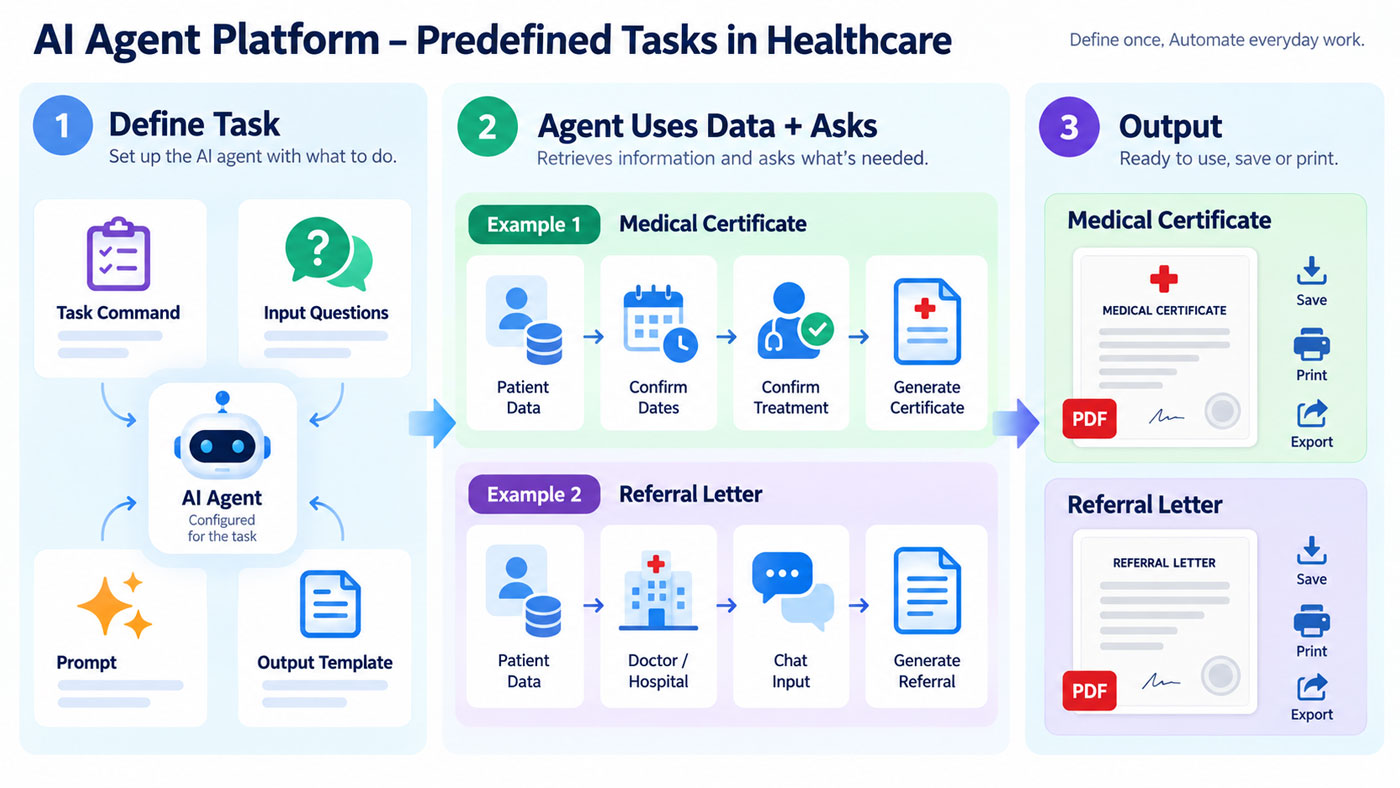
The distance between a good prompt and a running automation
Every organisation now has people who have found prompts that work. Someone in operations has a way of phrasing a request that reliably produces a decent summary. Someone in billing has one that extracts the right fields from a document. These live in notes applications and message threads.
Turning one of those into something that runs a thousand times a month, unattended, against real records, is a different discipline entirely. It needs a defined trigger, an input contract, a version history, a way to test a change before it reaches production, and a log showing what happened when it did not work.
The prompt is the smallest part. Everything around it is what makes it an automation rather than a trick.
The Agent Studio exists to close that gap. It gives a prompt the things software normally gets: a version number, a test environment, a release step and an observable production history.
What an agent is made of
Each stage is configured separately, which is what lets a non-engineer change one without touching the others.
Variables are typed rather than free text. An intake agent declares that it expects a patient name, a date of birth, an insurance reference and a reason for visit. If the trigger payload is missing one, that is a validation failure with a clear cause, not a model producing something confident about data it never received.
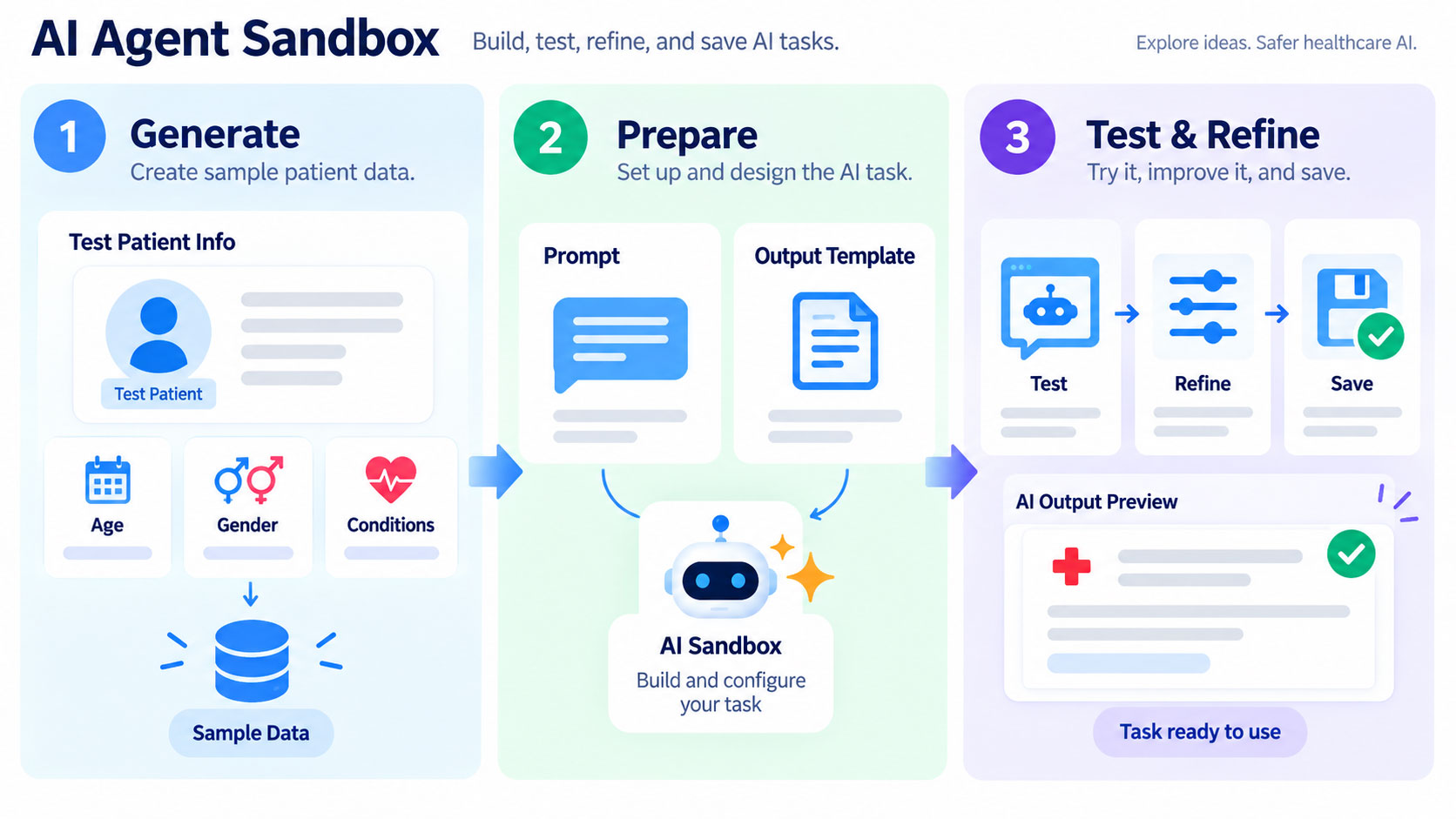
Test before publish, because prompts regress silently
Changing a prompt is deceptively risky. Traditional code fails loudly — a syntax error, a failed test, an exception. A worse prompt does not fail. It produces slightly less useful output on a subset of inputs, indefinitely, and nobody notices until someone reads the results carefully.
The sandbox is the answer. An agent can be run against sample payloads and inspected before it is published, and drafts are separate from the published version. The pattern is the same one software teams already use — staging, review, release — but applied to a prompt, because a prompt is now a production dependency.
An automation you cannot observe is one you cannot trust
Once agents run unattended, the important question stops being whether the prompt is good and becomes what happened last month. Every execution is logged with its trigger, duration, outcome and — when it fails — why.
Success rate per agent
Measured over time, so a decline after a prompt change is visible rather than inferred.
Failure reasons
Timeouts, validation failures and model errors are distinguished, because they have different fixes.
Duration
Execution time per run, which is both a cost signal and an early warning of degradation.
Trigger attribution
Which trigger fired each run, so a spike can be traced to its source rather than guessed at.
None of this is novel for conventional software. It is unusual for AI features, which are frequently shipped with no equivalent of an error log — and that gap is the reason a lot of AI automation quietly stops being used.
What the platform covers
Technology choices and why
The constraint that shaped this stack: agent definitions change weekly, and none of those changes should require redeploying the systems they act on.
NestJS microservices
Agent execution is isolated from the clinical services it reads. A misbehaving agent cannot degrade patient record access.
MongoDB
Agent definitions, prompt versions and run logs all have variable shape. Storing them as documents avoids a migration for every new configuration field.
Next.js
The studio is a configuration tool used by non-engineers, so the interface had to carry real complexity without looking like a developer console.
AWS Bedrock
Model access through a managed layer, so switching or adding a model is a configuration change rather than an integration project.
Claude
Strong instruction adherence, which matters disproportionately when the whole design depends on an agent staying inside its defined scope.
Sarvam AI
Indic language handling where agents process records or interactions that are not in English.
How the team built it
There is a symmetry worth naming: we used AI-assisted development to build a platform for AI-assisted operations, and the lesson transferred directly. Our engineers use Claude Code daily under review, and the discipline that makes that work — the human decides, the tool accelerates, everything is reviewed — is the same discipline the Agent Studio enforces on its users.
The agent model, the sandbox-before-publish requirement and the decision to log every run were the team's design choices. Every change passed normal review before merge.
Where it stands
The Agent Studio runs on the same service architecture as the LifeBridge EMR, hospital management and pharmacy platforms, so agents act on live operational data rather than on an exported copy.
Common questions
Can GegoSoft build an AI agent platform for us?
Yes. We have built one and use the same patterns in client work. The first question we ask is which processes are genuinely repeatable, because an agent platform is only worth building when there are several automations to manage rather than one.
How is this different from connecting an LLM API to our app?
An API call gives you one automation with no version history, no test environment and no run log. This gives you a way to manage many, change them safely, and see what happened when one failed.
Do non-engineers configure the agents?
That was the design intent — prompts, templates, variables and triggers are configuration rather than code. Defining a genuinely new trigger or output action is still engineering work.
What happens when an agent gets something wrong?
It is recorded with its inputs, duration and failure reason, so the cause is investigable. Agents that touch clinical decisions are designed to produce drafts for human review rather than to act unattended.
Can it use models other than Claude?
Yes. Model access goes through AWS Bedrock, so adding or switching a model is a configuration change. Sarvam AI is used alongside Claude for Indic language work.
Have prompts that work but nowhere to put them?
Tell us which processes you are trying to automate. We will tell you which are ready to be agents, which need the process fixed first, and which should stay with a person.
Start a conversation See all case studies