
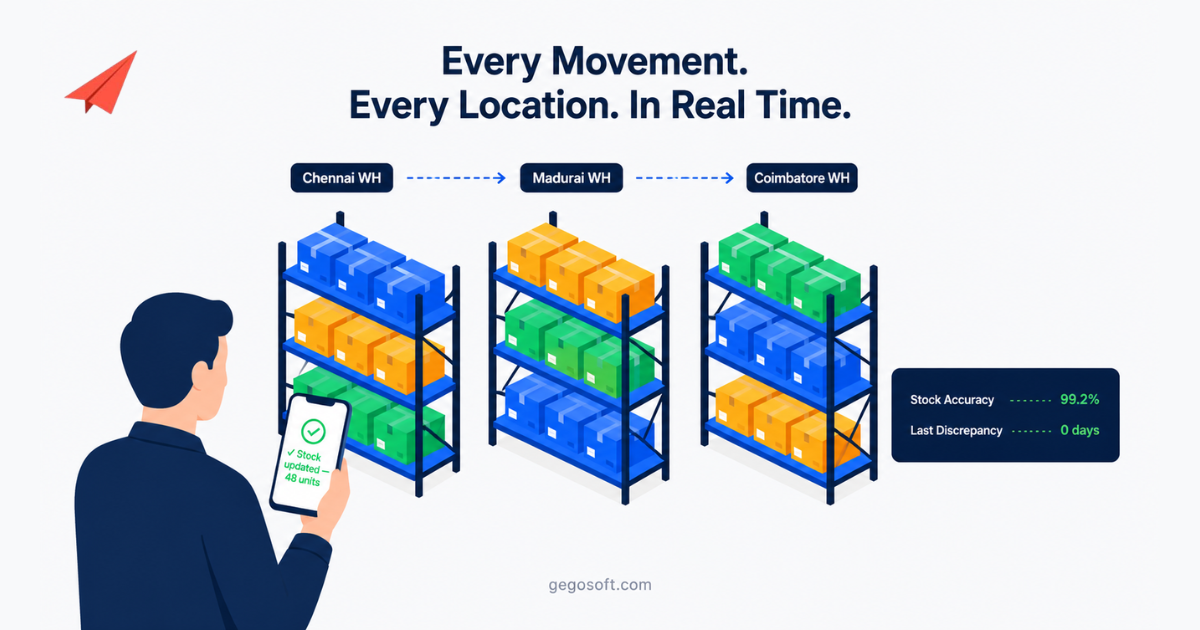
Every business that holds physical stock eventually discovers the same expensive truth: you cannot manage what you cannot see in real time. Overstocking ties up working capital in goods sitting on shelves. Understocking loses sales to customers who buy from a competitor who had it in stock. Stock discrepancies between what the system says and what is physically present erode margin silently, month after month, until a stock audit reveals losses that have been accumulating for a year.
For Indian businesses still managing inventory through Excel spreadsheets, paper registers, or disconnected billing software with no real inventory logic, this is not a hypothetical risk. It is a recurring cost that shows up in working capital tied up unnecessarily, in stockouts during peak demand, and in shrinkage that goes undetected until the annual audit.
This page covers what proper inventory management software should do, what it costs to build in India, and how GegoSoft Technologies approaches inventory system development.
Why Generic Inventory Software Fails Many Indian Businesses
The inventory software market is full of generic tools — Tally’s inventory module, Zoho Inventory, basic point-of-sale systems with stock tracking bolted on. For straightforward retail businesses with simple stock movements, these tools often work adequately.
The gap appears when a business has inventory logic that does not fit the generic model: multi-location stock that needs to be tracked separately but reported centrally, batch and expiry tracking for perishable or regulated goods, bill-of-materials logic where finished products consume multiple raw material components, serial number tracking for high-value items, or industry-specific compliance requirements that generic software was never built to handle.
When a business forces this complexity into a generic tool, the result is usually a combination of the software plus an Excel spreadsheet plus institutional memory held by one or two staff members who know which parts of the system to trust and which parts require manual correction. This hybrid approach is fragile — it depends on specific people remaining in their roles and remembering the workarounds.
Core Capabilities a Proper Inventory Management System Should Deliver
Real-Time Stock Visibility
The single most valuable capability of inventory software is knowing, at any moment, exactly how much of any item exists across every location — without waiting for a physical count or a end-of-day reconciliation. Every stock movement — receipt, sale, transfer, adjustment — should update the system instantly, not in a nightly batch process that leaves the day’s activity invisible until the following morning.
Multi-Location and Warehouse Management
For businesses operating across multiple stores, warehouses, or branches, inventory software needs to track stock at each location independently while providing consolidated visibility for management. Stock transfer requests between locations should be trackable from initiation to receipt confirmation, with discrepancies flagged automatically rather than discovered weeks later.
Purchase Order and Supplier Management
Automated reorder point alerts when stock falls below a configured threshold, purchase order generation and tracking from request through to goods receipt, and supplier performance tracking (delivery timeliness, quality issues, pricing history) turn procurement from a reactive scramble into a managed process.
Batch, Lot, and Expiry Tracking
For pharmaceuticals, food products, chemicals, and any regulated goods category, tracking which batch or lot a specific unit of stock belongs to — and its expiry date — is often a regulatory requirement, not just an operational convenience. Proper batch tracking enables FIFO (First In, First Out) stock rotation logic and rapid recall capability if a quality issue is identified in a specific batch.
Barcode and Serial Number Scanning
Barcode scanning eliminates the manual data entry errors that are the single largest source of inventory discrepancy in businesses still recording stock movements by hand. For high-value items, individual serial number tracking provides item-level traceability from receipt through to sale or disposal.
Bill of Materials and Manufacturing Inventory
For manufacturing and assembly businesses, inventory software needs to understand that producing one finished unit consumes a specific combination of raw material components — and should automatically deduct those components from raw material stock when production is recorded, while adding the finished good to finished goods inventory.
Reporting and Analytics
Stock valuation reports, slow-moving and dead stock identification, reorder forecasting based on historical consumption patterns, and shrinkage analysis comparing system stock to physical count results. These reports turn inventory data from a record-keeping function into a decision-making tool.
Industries With Specialised Inventory Requirements
Certain sectors have inventory logic complex enough that generic software consistently underperforms — and where a custom-built system delivers disproportionate value.
Construction and Building Materials — Material tracking against project Bill of Quantities, multi-site material allocation, and contractor-issued material reconciliation. GegoSoft’s Construction ERP handles this natively.
Pharmaceutical and Chemical Distribution — Batch tracking, expiry management, regulatory documentation, and hazardous material handling requirements that demand purpose-built logic rather than generic stock counting.
Manufacturing and Assembly — Bill of materials logic, work-in-progress tracking, and raw material consumption tied directly to production output.
Multi-Branch Retail — Centralised visibility across locations with location-specific stock levels, inter-branch transfer logic, and consolidated purchasing power analysis.
Healthcare and Laboratory Supplies — Regulatory compliance tracking, controlled substance logging, and integration with the broader hospital management systems that GegoSoft builds.
What a Custom Inventory System From GegoSoft Includes
| Module | Capability |
|---|---|
| Stock Tracking | Real-time quantity tracking by item, location, batch, and serial number where applicable |
| Purchase Management | PO generation, approval workflow, goods receipt matching, supplier performance tracking |
| Sales Integration | Automatic stock deduction on sale, integration with POS or eCommerce systems |
| Transfer Management | Inter-location transfer requests, in-transit tracking, receipt confirmation |
| Reorder Automation | Configurable reorder points, automated alerts, suggested purchase quantities based on consumption history |
| Barcode Support | Barcode generation and scanning for receiving, picking, and stock counts |
| Reporting Dashboard | Stock valuation, ageing analysis, turnover rate, shrinkage tracking |
| Audit Trail | Complete log of every stock movement with user, timestamp, and reason code |
| Mobile Access | Warehouse staff stock updates and counts from mobile devices, no desktop required |
Inventory Software Architecture: Built on Laravel
GegoSoft builds inventory management systems on Laravel PHP — chosen for its data integrity guarantees and the queue processing system needed to handle stock update events reliably even under high transaction volume.
Database design for inventory systems requires particular care around concurrency — when multiple staff members or systems update stock levels simultaneously (a sale, a transfer, and a stock count all happening within the same minute), the system must process these events correctly without race conditions producing incorrect stock figures. Laravel’s database transaction handling and queue-based event processing provide the reliability this requires.
For businesses needing mobile stock-taking and warehouse operations, GegoSoft’s mobile app development capability extends the inventory system to handheld devices with barcode scanning via the device camera, eliminating the need for dedicated barcode scanner hardware for smaller operations.
Inventory Management Software Pricing in India
GegoSoft provides fixed-price quotations after a discovery session mapping your specific stock complexity, location count, and integration requirements. Ranges below are indicative.
| Scope | What’s Included | Indicative Range | Timeline |
|---|---|---|---|
| Basic Inventory Module | Single location, stock tracking, purchase orders, basic reporting | ₹5 – ₹12 lakhs | 8–14 weeks |
| Multi-Location Inventory System | Multiple warehouses/branches, transfer management, consolidated reporting | ₹12 – ₹28 lakhs | 14–22 weeks |
| Manufacturing Inventory (BOM) | Bill of materials, production consumption tracking, WIP management | ₹18 – ₹40 lakhs | 18–28 weeks |
| Specialised Inventory (batch/regulatory) | Batch tracking, expiry management, compliance documentation | ₹15 – ₹45 lakhs | 16–28 weeks |
| Inventory + ERP Integration | Inventory as a module within a broader ERP system | Scoped per project | 20–40 weeks |
All engagements include milestone-based payment, 100% source code ownership, and a post-launch support period.
GegoSoft’s Inventory System Development Process
Phase 1 — Stock Workflow Discovery Mapping how stock actually moves through your business — receiving, storage, transfers, sales, returns, adjustments, and disposal — including the exceptions and edge cases that generic software documentation never anticipates.
Phase 2 — Database and Concurrency Architecture Designing the data model to handle your specific item categorisation, multi-location structure, and the concurrency requirements of your transaction volume — this is the foundation that determines whether the system remains accurate as usage scales.
Phase 3 — Module Development in Sprints Core stock tracking and purchase management built first, with reporting and advanced features (barcode scanning, mobile access, BOM logic) layered in subsequent sprints with working demonstrations at each stage.
Phase 4 — Data Migration Existing stock data from Excel, Tally, or previous systems migrated and validated — with particular attention to historical transaction data needed for accurate reorder forecasting and trend analysis from day one.
Phase 5 — Staff Training and Parallel Run Warehouse and purchasing staff trained on the new workflows. A parallel run period where both old and new systems operate simultaneously builds confidence before full cutover.
Phase 6 — Go-Live and Support Full cutover with the development team available for immediate issue resolution during the critical first weeks when staff are adapting to new workflows under real operational pressure.
Custom Inventory System vs. Generic Software
| Factor | Custom-Built (GegoSoft) | Generic Inventory Software | Excel + Manual Process |
|---|---|---|---|
| Matches your specific stock logic | Fully customised | Limited to vendor’s feature set | Entirely manual, error-prone |
| Multi-location complexity | Built to your structure | Often basic or premium-tier only | Extremely difficult to maintain accurately |
| Industry-specific requirements (batch, BOM) | Native support | Frequently absent or bolted-on | Not feasible at scale |
| Ongoing licensing cost | None — one-time development | Monthly per-user fees | None, but high labour cost |
| Real-time accuracy | Yes — designed for it | Varies by vendor | No — inherently delayed |
| Integration with existing systems | Built to specification | Limited to vendor’s integrations | Manual re-entry required |
Frequently Asked Questions
Q: How long does it take to build a custom inventory management system?
A: A basic single-location inventory module covering stock tracking, purchase orders, and reporting takes eight to fourteen weeks. A multi-location system with transfer management and consolidated reporting takes fourteen to twenty-two weeks. Systems with manufacturing bill-of-materials logic or specialised regulatory tracking take eighteen to twenty-eight weeks, depending on complexity.
Q: Can GegoSoft integrate inventory software with our existing billing or accounting system?
A: Yes. GegoSoft builds integrations between custom inventory systems and existing accounting software (Tally, QuickBooks, Zoho Books) and billing or POS systems. The integration approach depends on the APIs the existing system exposes — most modern accounting platforms support this, while older or highly customised systems may require a more involved integration build.
Q: Does the inventory system work with barcode scanners we already own?
A: Generally yes. GegoSoft builds barcode integration to work with standard USB and Bluetooth barcode scanners that output via keyboard emulation (the most common type), as well as mobile camera-based scanning through a companion app for warehouse staff using smartphones instead of dedicated scanner hardware.
Q: Can the system handle inventory across multiple warehouses with different stock levels?
A: Yes. Multi-location inventory tracking is a core capability — each location maintains its own stock levels, while management gets consolidated visibility across all locations. Inter-location transfer requests are tracked from initiation through to receipt confirmation, with automatic discrepancy flagging if the transferred quantity does not match what is received.
Q: What happens if our business processes change after the system is built?
A: Custom inventory systems built on clean architecture are designed to be extended. New item categories, additional locations, new reporting requirements, and integration with new systems are added as subsequent development engagements — typically faster and less expensive than the original build because the core data structure and business logic foundation already exists.
Q: Is a custom inventory system worth it for a smaller business, or only for large operations?
A: It depends on complexity, not size. A small business with straightforward single-location stock and no unusual requirements is often well served by an affordable generic tool. A small business with multi-location operations, batch tracking needs, or manufacturing logic — regardless of overall company size — benefits significantly from custom software, because the generic tools simply do not handle that complexity cleanly at any price point.
Inventory You Can See Is Inventory You Can Manage
The cost of poor inventory visibility compounds quietly — a little excess stock here, a missed reorder there, a discrepancy that goes uninvestigated because the system cannot tell you when or where it happened. Over a year, these small inefficiencies add up to a meaningful percentage of working capital and margin that a properly built system would have protected.
GegoSoft Technologies, based in Madurai, Tamil Nadu, India, builds inventory management systems designed around how your business actually moves stock — not how a generic software vendor assumed every business moves stock. The next step is a conversation about your specific operation.
View web application services →
Related services: Web App Development · Laravel Development · Mobile App Development · Construction ERP · SaaS Development