
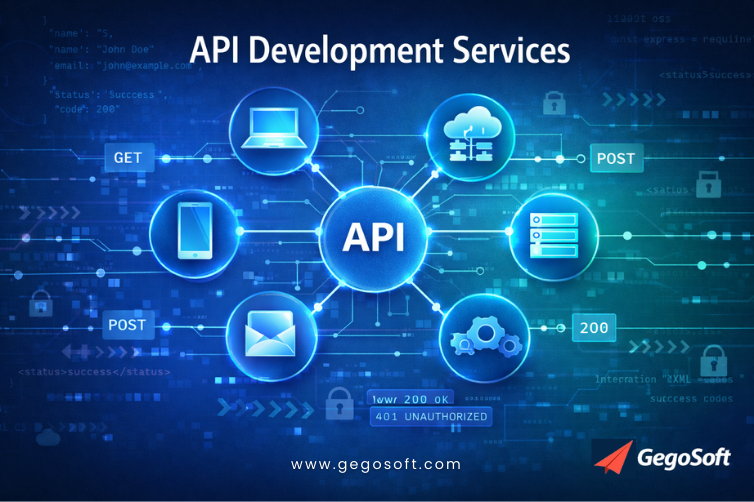
Every mobile app you use, every website integration you experience, and virtually every modern software interaction relies on APIs—Application Programming Interfaces—serving as the digital connective tissue enabling systems to communicate seamlessly. From payment processing and social media authentication to real-time data synchronization and third-party integrations, API development services create the foundations powering today’s interconnected digital ecosystem. Whether you’re building a mobile app requiring backend connectivity, creating a platform others will integrate with, or modernizing legacy systems through API-first architecture, professional API development services determine whether your integrations work reliably or frustrate users with errors and downtime.
The shift toward API-first development has accelerated dramatically, with 90% of organizations now considering APIs critical to business strategy. This guide explores how professional API development services create robust, secure, and scalable interfaces enabling the integrations modern applications demand.
Understanding API Development Services in 2025
API development services create interfaces allowing different software systems to communicate and exchange data programmatically. Rather than requiring manual data transfer or custom point-to-point integrations, APIs provide standardized methods for applications to request information or trigger actions in other systems. Modern API development services encompass RESTful APIs using HTTP protocols with JSON data, GraphQL APIs enabling flexible data queries, WebSocket APIs for real-time bidirectional communication, and gRPC for high-performance service-to-service communication.
Professional API development services extend beyond simply exposing endpoints. Comprehensive services include API design following industry best practices, security implementation protecting against unauthorized access, documentation enabling developers to integrate successfully, versioning strategies maintaining backwards compatibility, rate limiting preventing abuse, and monitoring systems tracking usage and performance. These components work together ensuring APIs remain reliable, secure, and maintainable as they scale from hundreds to millions of requests daily. When businesses partner with experienced development companies, they gain expertise spanning API architecture, security protocols, and operational best practices that distinguish production-grade APIs from amateur implementations.
Research indicates that companies with well-designed APIs see 30% faster partner integration, 40% reduced development costs for new features, and significantly improved developer satisfaction compared to those with poorly documented or inconsistent API implementations.
Strategic Advantages of Professional API Development Services
Investing in quality API development services delivers compelling benefits that impact operational efficiency, partnership opportunities, and competitive positioning.
Enables Mobile App and Third-Party Integration
Modern applications rarely operate in isolation. API development services create interfaces enabling mobile apps to access backend data, third-party developers to build on your platform, partner systems to exchange information automatically, and IoT devices to synchronize data. This connectivity expands reach beyond web interfaces, enables platform ecosystem development, and creates integration opportunities driving business growth. Companies with robust API development services attract developers building complementary services, accelerating ecosystem growth without internal development investment.
Facilitates System Modernization and Migration
Legacy system modernization often involves gradual replacement rather than risky “big bang” rewrites. API development services enable this through wrapping legacy systems with modern APIs, migrating functionality incrementally behind consistent interfaces, maintaining business continuity during transitions, and enabling new applications to coexist with legacy systems. This approach reduces risk while enabling progressive modernization aligning with business priorities and budget realities. Organizations avoid disruption while steadily improving technical foundations.
Accelerates Feature Development and Time-to-Market
Well-designed APIs dramatically accelerate development by enabling frontend and backend teams to work in parallel, providing reusable functionality across multiple applications, allowing new features to leverage existing services, and simplifying integration of third-party capabilities. Rather than rebuilding common functionality repeatedly, API development services create shared foundations accelerating subsequent projects. This efficiency proves crucial in competitive markets where speed determines success. When working with professional technology partners, API-first architecture becomes strategic advantage rather than technical implementation detail.
Creates Revenue Opportunities Through API Products
APIs themselves can become products generating revenue through subscription access to unique data or functionality, metered usage pricing for compute-intensive services, freemium models driving conversion to paid tiers, and partner ecosystems creating network effects. Successful API products like Stripe, Twilio, and Google Maps demonstrate how API development services transform internal capabilities into standalone businesses. Even companies not selling API access directly benefit from partner integrations driving customer acquisition and retention.
Core Components of Professional API Development Services
Quality API development services encompass multiple interconnected components ensuring APIs meet functional requirements while remaining secure, performant, and maintainable.
API Design and Architecture Planning
Effective API development services begin with thoughtful design defining resource modeling and URL structure, request/response format standardization, error handling and status code conventions, versioning strategy for evolution, and authentication/authorization approaches. Design decisions made early impact long-term maintainability, adoption rates, and integration difficulty. Professional services employ established patterns like REST architectural constraints or GraphQL schema design principles rather than inventing approaches from scratch. This consistency enables developers familiar with common patterns to integrate quickly without extensive learning curves.
Security Implementation and Access Control
API security represents critical priority in API development services since APIs often expose sensitive data or functionality. Security implementations include authentication verifying caller identity (OAuth 2.0, JWT tokens, API keys), authorization controlling access to specific resources, rate limiting preventing abuse and DOS attacks, input validation blocking injection attacks, and encryption protecting data in transit. Security vulnerabilities in APIs create breach risks affecting entire systems and damaging user trust. Professional API development services implement defense-in-depth strategies rather than relying on single security measures. When businesses engage security-conscious development teams, protection becomes foundational rather than afterthought retrofitted onto insecure foundations.
Comprehensive Documentation and Developer Experience
API adoption depends heavily on documentation quality. Professional API development services include interactive documentation with code examples, authentication guides and credential management, request/response examples for all endpoints, error codes and troubleshooting guidance, and SDK/library provision for popular languages. Tools like Swagger/OpenAPI automate documentation generation from code, ensuring docs stay synchronized with actual implementation. Poor documentation frustrates developers and kills adoption regardless of underlying API quality. Excellent documentation accelerates integration, reduces support burden, and differentiates professional API development services from amateur implementations.
Performance Optimization and Scalability
APIs must handle load gracefully as usage grows. API development services implement performance optimizations including efficient database queries and indexing, caching strategies at multiple layers, pagination for large result sets, asynchronous processing for long operations, and horizontal scaling for handling traffic spikes. Monitoring systems track response times, error rates, and usage patterns enabling proactive optimization. Professional services establish performance benchmarks during development rather than discovering capacity limits under production load.
API Development Approaches: REST, GraphQL, and Beyond
Professional API development services leverage appropriate architectural patterns based on use case requirements and client needs.
RESTful API Development
REST (Representational State Transfer) remains the dominant API development approach using HTTP methods (GET, POST, PUT, DELETE), resource-based URL structures, stateless request/response patterns, and standard response codes. RESTful API development services create intuitive interfaces leveraging familiar HTTP conventions. REST’s ubiquity means extensive tooling, framework support, and developer familiarity accelerating adoption. However, REST can require multiple requests for complex data needs and over-fetches data when clients need only specific fields. Despite limitations, REST remains default choice for most API development services due to simplicity and broad ecosystem support.
GraphQL API Development
GraphQL represents evolution beyond REST enabling clients to specify exactly what data they need, reducing over-fetching and multiple requests, strongly typed schemas providing clear contracts, and real-time subscriptions for live data. GraphQL API development services prove particularly valuable for mobile applications with bandwidth constraints, complex data relationships requiring aggregation, and scenarios where different clients need different data shapes. Tools like Apollo and Hasura simplify GraphQL API development while frameworks increasingly include native support. However, GraphQL introduces complexity around caching, N+1 query problems, and security considerations requiring specialized expertise. Professional API development services assess whether GraphQL’s benefits justify added complexity for specific use cases. When partnering with experienced backend developers, GraphQL implementation receives appropriate architectural consideration ensuring benefits outweigh costs.
WebSocket APIs for Real-Time Communication
Applications requiring real-time bidirectional communication—chat applications, collaborative tools, live dashboards—benefit from WebSocket API development services. WebSockets maintain persistent connections enabling instant data push rather than polling. This approach dramatically reduces latency and server load for real-time use cases. However, WebSockets introduce complexity around connection management, scaling across servers, and fallback handling for unsupported clients. Professional API development services implement WebSockets appropriately while maintaining REST/GraphQL APIs for standard request-response interactions.
gRPC for High-Performance Microservices
gRPC uses Protocol Buffers and HTTP/2 for high-performance service-to-service communication particularly common in microservices architectures. gRPC API development services deliver lower latency, smaller payloads, and stronger typing than REST, making it ideal for internal APIs where performance matters critically. However, gRPC requires specialized tooling and proves less accessible than REST for public APIs or web clients. Professional services select gRPC when performance requirements justify the tooling complexity.
Industry analysis shows that organizations implementing GraphQL alongside REST see 25% reduction in mobile data transfer and 35% fewer API calls, significantly improving mobile app performance while reducing infrastructure costs through more efficient data delivery.
API Development Best Practices for 2025
Following established best practices distinguishes professional API development services from amateur implementations that frustrate users and create maintenance nightmares.
Versioning Strategy and Backwards Compatibility
APIs evolve over time requiring changes to schemas, endpoints, or behavior. Professional API development services implement versioning strategies maintaining backwards compatibility while enabling evolution. Common approaches include URL versioning (api.example.com/v1/), header versioning specifying versions in request headers, and content negotiation using accept headers. Regardless of approach, clear deprecation policies, migration guides, and sufficient notice periods before breaking changes protect existing integrations. Poorly managed versioning destroys developer trust and creates integration fragility.
Comprehensive Error Handling and Status Codes
Clear error communication enables developers to debug integration issues quickly. API development services implement consistent HTTP status codes (200 for success, 400s for client errors, 500s for server errors), detailed error messages explaining what went wrong, error codes enabling programmatic handling, and troubleshooting guidance in documentation. Vague error responses like “Something went wrong” frustrate developers and generate support burden. Professional APIs communicate errors clearly enabling self-service debugging.
Rate Limiting and Abuse Prevention
Public APIs require protection against abuse, accidental DOS attacks, or malicious actors. API development services implement rate limiting restricting requests per time period, tiered limits based on subscription level, clear limit communication in response headers, and graceful degradation when limits are exceeded. Rate limiting protects infrastructure while ensuring fair resource distribution across users. Professional implementation communicates limits clearly and provides upgrade paths for legitimate high-volume users.
Monitoring, Logging, and Analytics
Understanding API usage patterns enables optimization and issue detection. API development services include comprehensive logging of requests and errors, performance monitoring tracking response times, usage analytics identifying popular endpoints, and alerting for anomalies or errors. These observability features enable proactive issue resolution before users report problems and inform optimization priorities based on actual usage rather than assumptions. When businesses work with professional development teams, monitoring becomes standard practice rather than afterthought, enabling data-driven optimization and rapid issue response.
API Security Considerations and Best Practices
Security represents paramount concern in API development services since APIs often expose sensitive functionality or data to external systems.
Authentication and Authorization Standards
Modern API development services implement industry-standard authentication including OAuth 2.0 for delegated access, JWT tokens for stateless authentication, and API keys for simpler use cases. Authorization controls ensure authenticated users only access permitted resources through role-based access control, scope limitations, and resource-level permissions. Security implementation must balance protection with developer experience—overly complex authentication discourages adoption while inadequate security creates breach risks.
Input Validation and Injection Prevention
APIs must validate all input preventing SQL injection, NoSQL injection, and other attack vectors. Professional API development services implement validation at multiple layers, use parameterized queries preventing SQL injection, sanitize inputs before processing, and enforce type and format requirements. Never trust client input—defense-in-depth assumes inputs may be malicious until proven otherwise through validation.
HTTPS Encryption and Transport Security
All API communication must use HTTPS encrypting data in transit. API development services configure proper SSL/TLS preventing man-in-the-middle attacks, implement HSTS headers forcing secure connections, and validate certificates properly. Unencrypted API traffic exposes authentication credentials, sensitive data, and creates compliance violations. HTTPS isn’t optional—it’s mandatory for professional API development services.
Frequently Asked Questions About API Development Services
What’s the difference between REST and GraphQL, and which should we use?
REST and GraphQL represent different API development approaches with distinct trade-offs. REST uses resource-based URLs with HTTP methods, remains simpler to implement, caches effectively, and enjoys broad tooling support. GraphQL enables clients to request exactly needed data, reduces over-fetching and multiple requests, and provides strongly typed schemas. Choose REST for simpler use cases, public APIs prioritizing caching, and scenarios where simplicity matters. Select GraphQL when mobile bandwidth constraints exist, complex data relationships require aggregation, or different clients need different data shapes. Many professional API development services implement both—REST for standard use cases and GraphQL where its benefits justify added complexity.
How much do professional API development services typically cost?
API development costs vary significantly based on complexity, security requirements, and integration scope. Simple REST APIs with basic CRUD operations might cost $15,000-$35,000, comprehensive API platforms with authentication, documentation, and monitoring typically range $50,000-$100,000, and complex API products with advanced features can exceed $150,000. Ongoing costs include infrastructure hosting, monitoring services, and maintenance. While significant investment, professional API development services deliver reliability, security, and documentation quality that DIY approaches rarely match, reducing long-term costs through fewer integration issues and support requirements.
How do we maintain backwards compatibility as our API evolves?
Maintaining backwards compatibility requires careful versioning strategy and disciplined development practices. Professional API development services implement URL or header versioning clearly indicating API versions, maintain old versions alongside new for transition periods, provide extensive migration documentation and guides, and establish clear deprecation policies with advance notice. Additive changes—new endpoints, optional fields—maintain compatibility while removal or modification of existing functionality requires new versions. Strong API contracts defined through OpenAPI/Swagger specifications help identify breaking changes during development before affecting users.
What security measures are essential for public-facing APIs?
Essential API security includes HTTPS encryption for all communication, authentication verifying caller identity (OAuth 2.0, JWT, or API keys), authorization controlling resource access, rate limiting preventing abuse, input validation blocking injection attacks, and comprehensive logging for security monitoring. Additional measures include CORS configuration restricting browser access, API keys with appropriate scopes limiting blast radius of compromised credentials, and regular security audits identifying vulnerabilities. When working with experienced development services, security receives appropriate priority throughout API development lifecycle rather than bolted on after implementation.
How do we document APIs effectively for developers?
Effective API documentation includes interactive documentation enabling testing directly, clear authentication guides with credential management instructions, comprehensive endpoint reference with request/response examples, error code catalog with troubleshooting guidance, and SDKs/libraries for popular languages. Tools like Swagger/OpenAPI generate documentation from code ensuring synchronization. Best practices include code examples in multiple languages, authentication workflow diagrams, common use case tutorials, and versioning documentation alongside code. Quality documentation dramatically accelerates developer adoption while reducing support burden. Professional API development services treat documentation as product feature rather than afterthought, investing in clarity and completeness that distinguishes excellent APIs from mediocre alternatives.
Build Robust APIs That Power Modern Integration
APIs serve as the foundation enabling modern software ecosystems, mobile applications, partner integrations, and system interconnections that users expect from contemporary digital experiences. Quality API development services create these foundations reliably, securely, and maintainably—enabling innovation rather than becoming bottlenecks constraining possibility. As applications grow increasingly interconnected and ecosystems become central to competitive strategy, professional API development distinguishes companies building platforms from those merely creating isolated applications.
At GegoSoft Technologies, our API development services combine architectural expertise with security implementation rigor and developer experience focus. We’ve delivered APIs powering mobile applications, enabling partner integrations, and modernizing legacy systems across industries. From initial design through implementation, documentation, security hardening, and production monitoring, we ensure APIs deliver the reliability, performance, and developer experience your business demands.
Ready to build APIs that enable seamless integration, power mobile experiences, and create platform opportunities? Contact our API development team today to discuss your integration requirements, security concerns, and vision for connected systems. Let’s create APIs that don’t just function technically but delight developers integrating with them while supporting your strategic business objectives.