
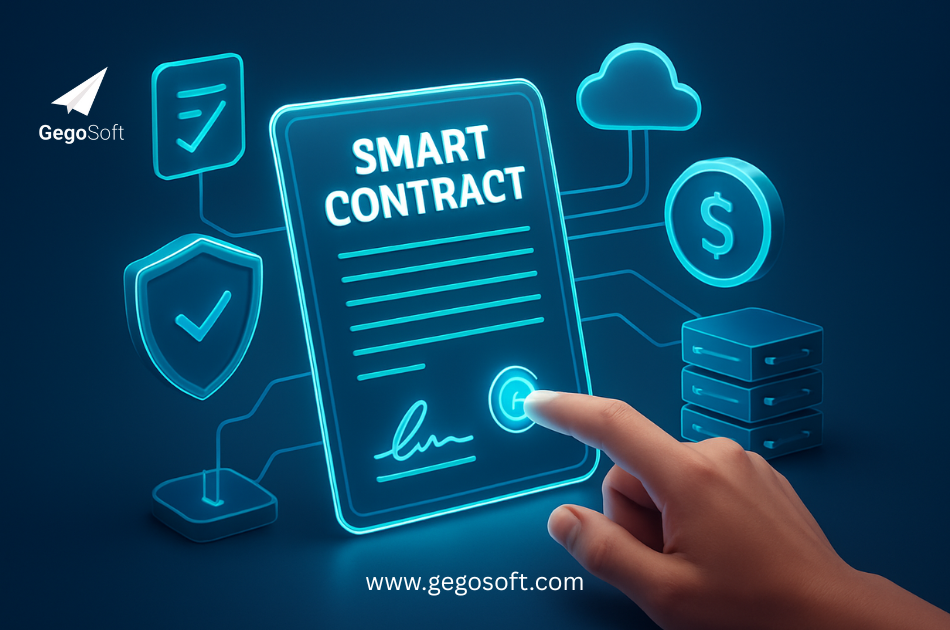
Imagine executing business agreements that enforce themselves automatically, eliminating intermediaries, reducing transaction costs, and removing the trust barriers that slow traditional contracts. This isn’t science fiction—it’s smart contract development, a revolutionary application of blockchain technology transforming how businesses conduct transactions, manage agreements, and establish trust in digital environments. Every day, billions of dollars flow through smart contracts powering decentralized finance, supply chain tracking, digital asset management, and innovative business models impossible with traditional contract mechanisms.
Smart contract development creates self-executing programs on blockchain networks where contract terms exist as code, automatically enforcing agreements when predefined conditions are met. No lawyers reviewing clauses, no intermediaries taking cuts, no disputes about whether obligations were fulfilled—just transparent, immutable, automated contract execution that all parties can trust. This comprehensive guide explores how smart contract development revolutionizes business processes and why organizations across industries increasingly invest in this transformative technology.
Understanding Smart Contract Development and Blockchain Technology
Smart contract development involves writing computer programs that execute on blockchain networks, automatically performing actions when specific conditions are satisfied. Unlike traditional contracts requiring human enforcement, smart contracts are self-executing and self-enforcing. When Alice sends payment to Bob for a service, a smart contract automatically releases the payment once Bob delivers the service, with no intermediary needed to hold funds or arbitrate disputes.
The foundation of smart contract development lies in blockchain technology’s core characteristics: decentralization, immutability, and transparency. Once deployed to a blockchain, smart contracts cannot be altered or deleted, ensuring parties cannot manipulate terms after agreement. All transactions execute publicly (though participant identities may be pseudonymous), creating verifiable audit trails. This transparency and immutability make smart contracts ideal for applications requiring trust between parties who may not know each other.
Professional smart contract development requires expertise spanning blockchain platforms like Ethereum, programming languages like Solidity or Rust, cryptographic principles ensuring security, and business logic translating real-world agreements into code. When organizations partner with experienced blockchain development companies, they gain access to specialists who understand both technical implementation and business applications, ensuring smart contracts deliver intended functionality while avoiding security vulnerabilities.
The global smart contract market is projected to reach $1.46 billion by 2028, growing at a compound annual rate of 24.2%, driven by increasing adoption in financial services, supply chain management, real estate, and healthcare sectors seeking to automate processes and reduce intermediary costs.
The Strategic Advantages of Smart Contract Development
Investing in smart contract development delivers numerous strategic benefits that directly impact operational efficiency, cost structures, and competitive positioning. Understanding these advantages helps justify investment and align stakeholder expectations around blockchain initiatives.
Elimination of Intermediaries and Associated Costs
Traditional business agreements require intermediaries—lawyers drafting contracts, escrow agents holding funds, notaries verifying signatures, arbitrators resolving disputes. Smart contract development eliminates these intermediaries by encoding agreement terms in self-executing code. When conditions are met, contracts execute automatically without human intervention, dramatically reducing transaction costs and settlement times from days to minutes.
The cost savings extend beyond direct fees. Intermediary elimination accelerates transaction speed, reduces administrative overhead, and minimizes disputes arising from subjective interpretation. Smart contract development creates frictionless business processes impossible with traditional contract mechanisms, enabling new business models and competitive advantages.
Transparency and Trust Without Central Authority
Smart contract development establishes trust through transparency and cryptographic verification rather than relying on trusted third parties. All parties can review smart contract code before agreeing, understanding exactly how the contract will execute. Once deployed, contract logic cannot be altered, and all transactions are permanently recorded on the blockchain, creating verifiable audit trails accessible to all participants.
This transparency proves particularly valuable when parties lack existing trust relationships or operate across jurisdictions with different legal systems. Smart contracts establish trust through mathematics and cryptography rather than legal enforcement, enabling global commerce between parties who have never met and may never interact again.
Automation of Complex Workflows and Business Logic
Beyond simple escrow arrangements, smart contract development enables automation of sophisticated business workflows involving multiple parties, conditional logic, and complex state management. Supply chain tracking, insurance claim processing, royalty distribution, and governance systems all benefit from smart contract automation, reducing manual processing while ensuring consistent, fair execution according to predefined rules.
Immutability and Dispute Reduction
Once deployed, smart contracts cannot be altered, preventing parties from claiming different terms than originally agreed. This immutability reduces disputes and provides definitive proof of agreement terms. Combined with automated execution, smart contract development eliminates most common sources of contractual disputes—interpretation ambiguity, execution delays, and one party claiming different terms than the other remembers.
Popular Platforms for Smart Contract Development
Smart contract development spans multiple blockchain platforms, each offering distinct characteristics, capabilities, and trade-offs. Understanding platform differences helps organizations select appropriate technologies for specific use cases.
Ethereum: The Original Smart Contract Platform
Ethereum pioneered smart contract development, creating the first blockchain specifically designed for running decentralized applications. Ethereum’s Solidity programming language has become the most widely used for smart contract development, supported by extensive documentation, developer tools, and a massive ecosystem of libraries and frameworks.
Ethereum smart contract development benefits from network effects—the largest developer community, most auditing firms, and broadest DeFi ecosystem all built on Ethereum. However, Ethereum has historically struggled with high transaction fees during network congestion. Ethereum 2.0 upgrades and Layer 2 scaling solutions address these limitations, making Ethereum smart contract development increasingly viable for diverse applications. Organizations working with innovative technology partners leverage both Ethereum mainnet and Layer 2 solutions optimally based on specific requirements.
Binance Smart Chain and Alternative EVM Chains
Binance Smart Chain and other Ethereum Virtual Machine (EVM) compatible blockchains offer smart contract development environments compatible with Ethereum tooling while providing faster transaction speeds and lower fees. This compatibility enables developers to port Ethereum smart contracts with minimal modifications, accelerating development while reducing costs.
These alternative platforms trade some decentralization for performance and cost efficiency. For applications where performance and fees outweigh maximum decentralization, smart contract development on EVM-compatible chains provides practical alternatives to Ethereum mainnet.
Hyperledger Fabric for Enterprise Smart Contracts
Enterprise smart contract development often targets private, permissioned blockchains like Hyperledger Fabric. Unlike public blockchains where anyone can participate, Hyperledger Fabric creates private networks where known entities participate, providing greater control over data visibility while maintaining blockchain benefits like distributed consensus and immutability.
Hyperledger smart contract development (called “chaincode”) uses general-purpose programming languages like Go, Java, or JavaScript rather than specialized languages like Solidity. This flexibility and privacy make Hyperledger popular for enterprise consortiums where multiple organizations share infrastructure while maintaining confidentiality requirements.
Solana, Cardano, and Next-Generation Platforms
Newer blockchain platforms like Solana and Cardano offer alternative approaches to smart contract development. Solana emphasizes performance, achieving thousands of transactions per second at minimal cost. Cardano focuses on formal verification methods ensuring smart contract correctness through mathematical proofs, potentially reducing security vulnerabilities.
These platforms use different programming languages—Rust for Solana, Plutus for Cardano—requiring specialized smart contract development expertise. However, their technical innovations attract projects requiring capabilities beyond what earlier platforms provide.
Security audits reveal that 60% of smart contracts contain vulnerabilities when initially developed, emphasizing the critical importance of partnering with professional smart contract development teams who implement rigorous testing, security reviews, and formal verification methods before deployment.
The Smart Contract Development Process
Professional smart contract development follows structured methodologies ensuring contracts function correctly, securely, and efficiently while meeting business requirements.
Requirements Analysis and Use Case Validation
Smart contract development begins with thorough analysis determining whether blockchain and smart contracts appropriately address the use case. Not every business process benefits from blockchain implementation—centralized databases often prove more efficient when parties already trust each other or a central authority is acceptable.
Requirements analysis clarifies business logic, identifies parties involved, documents conditions triggering contract execution, specifies data inputs and outputs, and establishes success criteria. This foundation ensures smart contract development addresses actual business needs rather than implementing blockchain for technology’s sake.
Architecture Design and Platform Selection
With requirements established, architects design smart contract architecture selecting appropriate blockchain platforms, determining whether public or private blockchains suit the use case, planning data structures and state management, designing interactions between multiple contracts, and identifying integration points with off-chain systems.
Platform selection involves evaluating transaction throughput requirements, acceptable latency, cost constraints, privacy needs, and desired decentralization levels. Each blockchain platform offers different trade-offs, and professional smart contract development teams guide these critical architectural decisions based on specific requirements. When businesses engage experienced blockchain specialists, architectural planning ensures long-term success rather than discovering platform limitations after development.
Development, Testing, and Security Auditing
Smart contract development requires meticulous coding practices because deployed contracts cannot be modified. Developers write contract code, implement comprehensive unit tests, conduct integration testing with other contracts and systems, perform security analysis identifying vulnerabilities, and optimize gas efficiency reducing transaction costs.
Testing occurs in local development environments, public testnets mimicking production conditions, and through automated security analysis tools. However, automated testing alone proves insufficient. Professional smart contract development includes manual security audits by specialized firms who identify vulnerabilities automated tools miss. Third-party audits provide independent verification of contract security before deployment to mainnet where vulnerabilities could result in catastrophic losses.
Deployment and Ongoing Management
Deploying smart contracts involves careful preparation including final security reviews, deployment to testnet for final validation, mainnet deployment when confidence is high, and verification of deployed contract code allowing public scrutiny. Post-deployment, smart contract development teams monitor contract interactions, track performance metrics, respond to discovered issues, and plan upgrade strategies for evolving requirements.
While smart contracts are immutable, upgrade patterns exist enabling evolution while preserving data and maintaining backwards compatibility. Professional teams architect contracts with upgradeability in mind when appropriate, balancing immutability benefits against flexibility needs.
Common Applications of Smart Contract Development
Smart contract development enables diverse applications across industries, solving longstanding problems around trust, transparency, and automation.
Decentralized Finance (DeFi) Protocols
DeFi represents the most prominent smart contract development application, recreating financial instruments—lending, borrowing, trading, derivatives—without intermediaries. DeFi protocols enable users to lend assets earning interest, borrow against collateral, trade assets on decentralized exchanges, provide liquidity earning fees, and participate in complex financial strategies, all through smart contracts executing transparently on public blockchains.
Supply Chain Tracking and Verification
Smart contract development creates transparent supply chain systems tracking products from manufacture through delivery. Contracts automatically update as goods change hands, verify authenticity, trigger payments upon delivery confirmation, and create immutable audit trails proving provenance. This transparency combats counterfeiting, improves efficiency, and provides consumers with verifiable product histories.
Digital Asset Management and NFTs
Non-fungible tokens (NFTs) leverage smart contract development to create unique digital assets with verifiable ownership and provenance. Beyond digital art, NFTs represent event tickets, real estate titles, intellectual property rights, and gaming items. Smart contracts govern NFT creation, trading, royalty distribution, and utility, enabling new digital asset classes and business models.
Automated Insurance and Parametric Products
Smart contract development enables parametric insurance products that pay out automatically when predefined conditions occur—flight delays, crop failures, natural disasters—without claims processing. Contracts monitor external data sources (oracles) and execute payouts automatically when triggering events occur, dramatically reducing administrative costs while accelerating claim settlement.
Governance and Decentralized Autonomous Organizations
DAOs use smart contract development to create organizations governed by code rather than traditional hierarchies. Members propose initiatives, vote on decisions, and smart contracts automatically execute approved actions—fund allocation, parameter changes, membership management—without centralized control. This enables new organizational structures where governance is transparent, verifiable, and resistant to capture by special interests.
Security Considerations in Smart Contract Development
Security represents the most critical aspect of smart contract development. Unlike traditional software where bugs can be patched, smart contract vulnerabilities may be permanent and have resulted in losses exceeding hundreds of millions of dollars.
Common Smart Contract Vulnerabilities
Smart contract development must guard against reentrancy attacks where malicious contracts recursively call victim contracts draining funds, integer overflow/underflow causing unexpected behavior, access control issues allowing unauthorized actions, front-running where attackers observe pending transactions and manipulate ordering, and oracle manipulation where external data sources provide false information.
Security Best Practices and Auditing
Professional smart contract development implements defense-in-depth strategies including extensive testing with high code coverage, formal verification proving contract correctness mathematically, bug bounty programs incentivizing security researchers to find vulnerabilities, third-party security audits by specialized firms, and adherence to established security patterns and standards.
Security audits should occur before mainnet deployment and after any significant updates. Reputable smart contract development teams engage multiple audit firms for critical contracts, understanding that security represents ongoing vigilance rather than one-time verification. Organizations partnering with professional development firms ensure security receives appropriate priority throughout development lifecycles.
Ongoing Security Monitoring
Post-deployment, smart contract development teams implement monitoring systems tracking unusual activity, unexpected state changes, or interaction patterns suggesting attacks. Automated alerts enable rapid response to potential security incidents, while regular reviews ensure deployed contracts behave as expected even as ecosystems evolve around them.
FAQs About Smart Contract Development
1. What programming languages are used for smart contract development?
Smart contract development uses various languages depending on the blockchain platform. Solidity dominates Ethereum and EVM-compatible chain development, resembling JavaScript with some C++ influence. Vyth in provides an alternative Ethereum language emphasizing security through simplicity. Rust is used for Solana and Polkadot smart contract development, offering memory safety without garbage collection. Hyperledger Fabric supports general-purpose languages including Go, JavaScript, and Java. Learning smart contract development typically begins with Solidity due to its widespread adoption, extensive resources, and largest developer community.
2. How much does professional smart contract development cost?
Smart contract development costs vary dramatically based on complexity, security requirements, and audit needs. Simple contracts might cost $5,000-$15,000 for development, while complex DeFi protocols or multi-contract systems can exceed $100,000-$300,000 including development, testing, auditing, and deployment. Security audits alone typically range from $10,000-$100,000+ depending on contract complexity and auditor reputation. While significant investment, professional smart contract development with proper security auditing proves far less expensive than vulnerabilities resulting in contract exploits and fund losses that have cost projects hundreds of millions.
3. Can smart contracts be changed or updated after deployment?
Smart contracts deployed to blockchains are immutable by default—code cannot be changed after deployment. However, smart contract development teams can implement upgrade patterns enabling evolution while preserving user assets and contract data. Common approaches include proxy patterns where user-facing contracts delegate to upgradeable implementation contracts, and contract migration strategies where users transition to new contract versions. Each approach involves trade-offs between flexibility and security. Some applications intentionally avoid upgradeability, ensuring users can trust that contract logic will never change, while others require flexibility to fix bugs or add features.
4. How do smart contracts interact with real-world data and external systems?
Smart contracts execute on blockchains and cannot directly access external data or systems. Smart contract development addresses this limitation through oracles—trusted data providers that feed information onto blockchains. Oracles enable contracts to react to real-world events like weather conditions, flight statuses, price feeds, or API responses. Professional smart contract development carefully designs oracle integrations, understanding that oracle manipulation represents a significant attack vector. Decentralized oracle networks like Chainlink provide increased security through consensus across multiple data sources, reducing single points of failure and manipulation risks.
5. What industries benefit most from smart contract development?
Smart contract development delivers value across numerous industries. Financial services leverage contracts for DeFi protocols, automated trading, and settlement systems. Supply chain and logistics use contracts for tracking, verification, and automated payments. Real estate benefits from tokenization, fractional ownership, and automated rent collection. Healthcare applies contracts to patient consent management, insurance claim processing, and clinical trial coordination. Gaming and entertainment use contracts for digital asset ownership, in-game economies, and royalty distribution. Insurance implements parametric products with automated payouts. Any industry involving multi-party agreements, value transfer, or processes requiring trust without central authority can benefit from smart contract development.
Embracing the Future with Professional Smart Contract Development
Smart contract development represents more than technological innovation—it fundamentally reimagines how businesses establish trust, automate processes, and conduct transactions in digital environments. As blockchain technology matures and adoption accelerates, organizations that strategically leverage smart contracts gain competitive advantages through reduced costs, faster processes, and novel business models impossible with traditional approaches.
The path to successful smart contract implementation requires more than coding ability—it demands deep understanding of blockchain platforms, cryptographic security, business logic translation, and the unique constraints of decentralized systems. Security cannot be an afterthought; the immutability that makes smart contracts powerful also makes vulnerabilities permanent and potentially catastrophic.
At GegoSoft Technologies, our smart contract development services combine blockchain expertise with security-first practices and business acumen. We’ve successfully delivered smart contracts across use cases from DeFi protocols to supply chain solutions, consistently prioritizing security through comprehensive testing, formal verification, and third-party auditing. From initial consultation through architecture design, development, security auditing, deployment, and ongoing support, we partner with you to harness blockchain technology safely and effectively.
Ready to explore how smart contract development can transform your business processes, reduce intermediary costs, and create new opportunities through blockchain technology? Let’s discuss your specific use case, technical requirements, and vision for decentralized solutions. Contact our blockchain development team today to schedule a consultation and discover how smart contracts can drive innovation and efficiency in your organization while maintaining the security and reliability your business demands.