
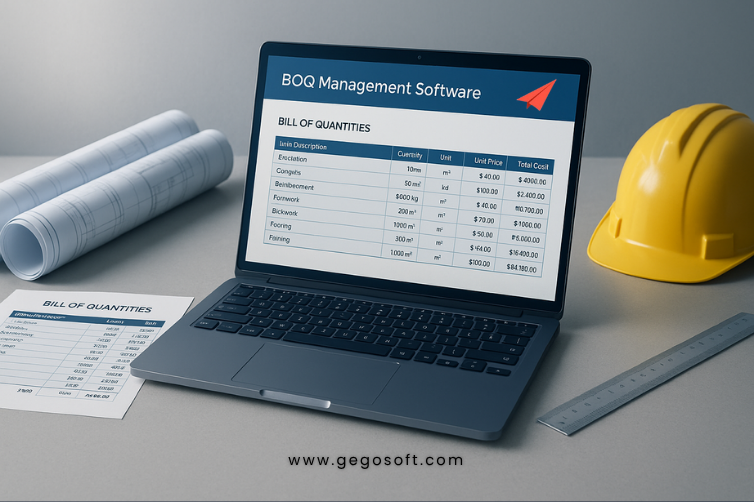
Understanding BOQ in construction is fundamental to successful project execution, accurate cost estimation, and transparent bidding processes. Whether you’re a contractor, project manager, or quantity surveyor, mastering Bill of Quantities preparation and management can significantly impact your project’s profitability and efficiency. This comprehensive guide explores everything you need to know about BOQ, from its definition to modern digital management solutions.
What is BOQ in Construction?
A BOQ in construction (Bill of Quantities) is a detailed document that itemizes all materials, labor, equipment, and services required to complete a construction project. Prepared by quantity surveyors or cost consultants, this comprehensive list includes precise quantities, unit measurements, rates, and total costs for every component of the project.
The BOQ serves as the financial blueprint of any construction project, enabling contractors to submit accurate bids, project owners to compare proposals fairly, and teams to track costs throughout the construction lifecycle. It acts as a critical communication tool linking clients, consultants, and contractors through standardized measurements and specifications.
Key Components of a Construction BOQ
Essential Elements Every BOQ Must Include
Item Numbering and Description Each entry in the BOQ receives a unique identifier for easy reference and tracking. Detailed descriptions specify the exact work to be performed, materials to be used, and quality standards to be met, ensuring all stakeholders understand project requirements clearly.
Quantity Measurements Accurate quantity calculations form the foundation of reliable BOQ. Measurements are expressed in appropriate units—cubic meters for concrete, square meters for flooring, linear meters for piping, or numbers for fixtures. These measurements derive from detailed analysis of architectural drawings and specifications.
Unit Rates and Costs Each item includes a unit rate representing the cost per measurement unit. These rates encompass material costs, labor charges, equipment expenses, and contractor margins. Total costs multiply unit rates by quantities, providing clear financial visibility for every project element.
Work Specifications Technical specifications detail material grades, construction methods, quality standards, and compliance requirements. This information ensures contractors understand exactly what’s expected and can price work accordingly without ambiguity.
The Critical Role of BOQ in Construction Projects
Enabling Accurate Cost Estimation
BOQ transforms vague project concepts into precise financial forecasts. By breaking down complex construction projects into measurable components, it allows contractors to calculate exact material needs, labor requirements, and equipment costs. This granular approach minimizes estimation errors that often lead to budget overruns or contractor losses.
Facilitating Fair and Transparent Bidding
When all contractors receive identical BOQ documents during tender processes, they price the same work scope using the same measurements. This standardization eliminates guesswork, ensures fair competition, and enables project owners to compare bids objectively based on rates rather than varying quantity interpretations.
Supporting Effective Cost Control
Throughout project execution, BOQ serves as the baseline for monitoring expenses. Project managers compare actual material consumption and labor deployment against BOQ projections, identifying variances early and implementing corrective actions before minor deviations become major overruns.
Streamlining Contract Administration
BOQ becomes the reference document for progress payments, change order evaluation, and dispute resolution. When changes occur—as they inevitably do in construction—the BOQ provides the framework for assessing cost impacts and adjusting contracts appropriately.
Types of BOQ Used in Modern Construction
Elemental Bill of Quantities
Organized by building elements such as foundations, walls, roofs, and finishes, elemental BOQ groups related work items together. This format aids cost planning by building component and facilitates design team coordination across architectural, structural, and MEP disciplines.
Trade-Based Bill of Quantities
Arranged according to construction trades like masonry, carpentry, plumbing, and electrical work, this format aligns with typical subcontractor specializations. It simplifies subcontractor bidding and helps general contractors manage trade-specific scope boundaries.
Activity-Based Bill of Quantities
Structured around construction activities in sequence, this approach links directly to project schedules. It supports integrated planning where cost, schedule, and resource allocation align seamlessly for improved project control.
Preparing an Accurate Construction BOQ: Step-by-Step Process
Step 1: Complete Design Documentation
BOQ preparation requires finalized architectural, structural, and MEP drawings along with detailed specifications. Incomplete designs lead to inaccurate quantities, requiring costly revisions during construction. Ensure all design disciplines coordinate before beginning quantity takeoff.
Step 2: Systematic Quantity Takeoff
Analyze drawings methodically to identify every component requiring quantification. Measure systematically—proceed room by room, floor by floor, or trade by trade. Record measurements in standardized formats, noting assumptions and including appropriate waste allowances for each material type.
Step 3: Rate Analysis and Pricing
Determine unit rates through market surveys, supplier quotations, and historical data analysis. Consider current market conditions, project location factors, and timing when establishing rates. Include all cost components: materials, labor, equipment, overhead, and profit margins.
Step 4: Documentation and Formatting
Organize quantities into clear, logical sections with consistent formatting. Include comprehensive descriptions that eliminate ambiguity. Add preambles explaining measurement methods, assumptions, and any special conditions affecting pricing or execution.
Step 5: Review and Validation
Conduct thorough reviews checking arithmetic accuracy, measurement consistency, and completeness. Peer reviews or independent checks by experienced quantity surveyors catch errors before tender issuance, preventing costly disputes later.
Common Challenges in BOQ Management
Measurement Errors and Omissions
Inaccurate measurements rank among the most frequent BOQ problems. Complex geometries, unclear drawings, or rushed takeoff processes lead to quantity errors. Double-counting items or completely omitting work components creates significant financial discrepancies.
Rate Assumptions and Market Fluctuations
Establishing accurate unit rates challenges even experienced estimators. Material prices fluctuate, labor availability varies, and local market conditions shift. Rates that seemed reasonable during preparation may not reflect actual costs during construction months later.
Design Changes During Construction
Projects rarely proceed exactly as originally designed. Changes driven by client requests, site conditions, or regulatory requirements necessitate BOQ adjustments. Managing these variations while maintaining accurate cost tracking demands systematic change order processes.
Coordination Across Multiple Trades
Complex projects involve numerous specialized contractors whose scopes must mesh seamlessly. Ensuring BOQ clearly delineates responsibility boundaries prevents disputes over who supplies what materials or performs which activities.
Digital Transformation: Modern BOQ Management Software
Moving Beyond Traditional Spreadsheets
While spreadsheets suffice for small projects, they become unwieldy as complexity increases. Manual data entry invites errors, version control challenges multiply, and real-time collaboration proves difficult. Modern construction demands more sophisticated solutions.
Advantages of Specialized BOQ Software
Dedicated construction estimation and management software revolutionizes BOQ handling through automation, integration, and real-time visibility. Digital platforms eliminate redundant data entry, automatically calculate totals, and update all related documents when changes occur.
Automated Quantity Takeoff Advanced software extracts quantities directly from digital drawings, significantly accelerating takeoff processes while improving accuracy. Automated measurements eliminate manual calculation errors and ensure consistent measurement methods across projects.
Integrated Cost Tracking Link BOQ directly to procurement, inventory, and accounting systems. Track actual costs against estimates in real-time, identifying variances immediately. This integration provides unprecedented visibility into project financial health.
Collaborative Workflows Cloud-based platforms enable simultaneous access by multiple team members—estimators, project managers, procurement specialists, and executives—all working from the same current data. Changes propagate instantly to all stakeholders.
Template Libraries and Standardization Build libraries of standard BOQ formats, rate databases, and measurement methods. Standardization across projects improves consistency, reduces preparation time, and facilitates benchmarking and continuous improvement.
Comprehensive Reporting and Analytics Generate detailed reports analyzing costs by trade, activity, or time period. Compare estimated versus actual performance, identify trends, and make data-driven decisions supported by comprehensive project analytics.
Best Practices for BOQ Excellence
Maintain Comprehensive Documentation
Document all assumptions, measurement methods, and rate sources. Thorough documentation prevents misunderstandings, supports dispute resolution, and provides valuable reference material for future projects.
Build Contingencies Appropriately
Include reasonable contingency allowances for unforeseen conditions, design development, and market fluctuations. Contingencies shouldn’t hide poor estimating but should recognize construction project realities.
Regular Updates Throughout Project Lifecycle
Treat BOQ as a living document, not a one-time deliverable. Update regularly as actual costs materialize, changes occur, and project understanding deepens. Current BOQ data enables informed decision-making at every project stage.
Leverage Historical Data
Maintain databases of completed project costs. Historical data provides reliable benchmarks for future estimates, reveals cost trends, and improves estimating accuracy over time through organizational learning.
Invest in Team Training
BOQ preparation requires specialized skills combining technical knowledge, construction understanding, and analytical capabilities. Invest in training estimators, project managers, and quantity surveyors in best practices, software tools, and emerging methodologies.
Industry Standards and Methodologies
New Rules of Measurement (NRM)
The Royal Institution of Chartered Surveyors’ NRM standards provide internationally recognized frameworks for quantity measurement and cost estimation. Following standardized methodologies ensures consistency and professionalism in BOQ preparation.
Local Standards and Practices
Different regions maintain specific measurement standards, cost formats, and contractual frameworks. Understanding local practices proves essential when working across different markets or jurisdictions.
The Future of BOQ Management
Building Information Modeling (BIM) Integration
BIM technology revolutionizes quantity takeoff by embedding cost data directly into 3D models. As designs evolve, quantities update automatically. This integration dramatically improves accuracy and eliminates traditional takeoff delays.
Artificial Intelligence and Machine Learning
AI-powered platforms learn from historical data to predict costs, identify risks, and suggest optimizations. Machine learning algorithms detect patterns human estimators might miss, continuously improving estimation accuracy.
Real-Time Data Integration
Future systems will integrate real-time material pricing, labor availability, and market conditions directly into BOQ. Dynamic pricing models adjust automatically to current market realities, maintaining estimate accuracy despite changing conditions.
Conclusion: Mastering BOQ for Construction Success
Effective BOQ in construction management separates successful projects from troubled ones. Accurate, comprehensive bills of quantities enable realistic budgeting, fair contractor selection, and proactive cost control throughout project execution. While traditional manual methods still work for simple projects, modern construction complexity demands digital solutions.
Investing in professional construction estimation and management software transforms BOQ from a tedious administrative task into a strategic advantage. Automated takeoff, integrated tracking, and real-time visibility empower construction professionals to manage projects more effectively, control costs more tightly, and deliver better outcomes for clients.
Whether you’re preparing your first BOQ or looking to optimize established processes, understanding these fundamentals and embracing modern tools positions you for construction project success. The construction industry’s increasing complexity and competitive intensity make BOQ excellence not just beneficial but essential for sustainable business growth.
Looking to streamline your construction estimation and BOQ management? Discover how modern software solutions can transform your project planning and cost control capabilities.