
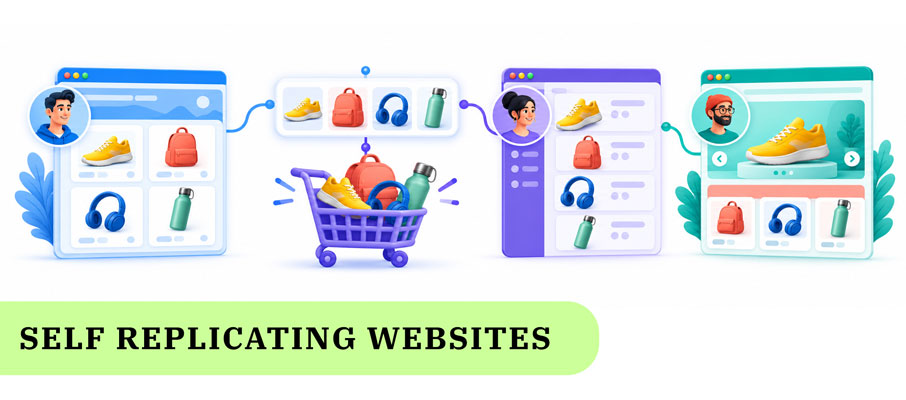
A self-replicating website script gives every seller their own personalised copy of a brand's online store, while the brand keeps one catalogue, one set of prices and one checkout behind all of them.
- What it is
- Software that creates a personalised storefront for each registered seller from one master site
- Also called
- Replicated website, replicated storefront, seller store
- Who uses it
- Direct-selling brands, distributor-led eCommerce and brand ambassador programmes
- Core functions
- Per-seller URLs, shared catalogue, central checkout, sales attribution
- Our stack
- Laravel API and admin, Nuxt (Vue) storefront and seller app
- Built by
- GegoSoft, Madurai, India
What is a self-replicating website script?
It is software that automatically creates an individual website for each seller in a brand's network. Every seller gets a store at their own address, such as name.brand.com or brand.com/name, showing their name, photo and contact details.
The products, prices, offers and policy pages all come from the brand. Sellers personalise their profile and choose which products to feature, but they cannot change prices or product claims. Nothing is copied page by page: one codebase renders a different seller's version of the store depending on the address a customer visits.
How it works
- A seller registers. The brand verifies and approves them, and the system creates their store automatically.
- The seller gets an address. A subdomain, a path on the main domain or, for larger sellers, their own domain.
- The seller sets up their profile. Name, photo, short bio, contact details and featured products.
- The brand updates once. New products, price changes and promotions appear in every seller's store at the same moment.
- A customer buys. Checkout, payment and inventory run centrally, and the order is credited to the seller whose store it came from.
- Everyone sees results. Each seller sees their own orders and earnings; the brand sees the whole network.
Because every seller store shows the same product content, each one points search engines back to the brand's main product pages with canonical tags. That keeps the network from creating duplicate-content problems.
How it helps direct sellers in eCommerce
- A professional store from day one. Sellers do not need to build, host or pay for their own website.
- A link they can share anywhere. WhatsApp, Instagram, email or a business card, with every visit tracked back to them.
- Credit for every sale. Clear attribution ends disputes over who made a sale, including when a customer comes back later.
- Consistent, compliant information. Prices and product claims stay exactly as the brand approved them, which matters in categories like wellness, cosmetics and food.
- Less admin for the brand. One update reaches every seller store; there is nothing to chase.
- Data the brand owns. Customers, orders and performance stay in one central system.
In India, direct-selling businesses also need to meet the Consumer Protection (Direct Selling) Rules, 2021, which cover areas such as seller identification, product information and grievance handling. A replicated store can show these details consistently on every seller page.
How GegoSoft builds it
We first worked through this architecture when we built GegoCart, a multi-seller eCommerce platform we released as open source under the MIT licence. It has three parts: an admin and API built with Laravel, a buyer storefront built with Nuxt, and a seller app built with Nuxt.
A multi-seller marketplace and a replicated website are the same idea seen from two sides. A marketplace shows every seller inside one store; a replicated site shows one seller's view of the brand's store. Both depend on the same foundations: sellers, a shared catalogue and reliable order attribution.
What carries over into client builds
- The seller data model, commission handling and attribution logic
- The separation of brand admin, seller app and customer storefront
- Admin workflows for approving sellers and managing the catalogue
What we add for each brand
- The replication layer: subdomain, path or custom-domain stores
- Seller personalisation and featured products
- Compliance details for the brand's market
- Integrations such as payment gateways, shipping, ERP and WhatsApp sharing
GegoCart itself is no longer maintained, so client projects start on current versions of Laravel and Nuxt. Our engineers use Claude Code as everyday tooling, which makes extending a proven architecture fast and keeps the first working version short to reach.
What we build, and what we don't
We build replicated storefronts for brands selling real products to real customers. We do not build recruitment-fee schemes, income-guarantee platforms or investment-return systems.
Frequently asked questions
What is a self-replicating website script?
A self-replicating website script is software that automatically creates a personalised website for each seller in a brand's network. Each seller gets their own address and profile, while products, prices and checkout are managed centrally by the brand.
Is a replicated website the same as an affiliate link?
No. An affiliate link sends visitors to the brand's main site with a tracking code. A replicated website gives the seller a complete storefront with their own name, photo and featured products, and every order placed there is credited to them.
Should sellers get a subdomain, a path or their own domain?
A path such as brand.com/name is simplest and keeps all search value on the main domain. A subdomain such as name.brand.com looks more personal. Custom domains suit established sellers but cost more to manage. Many brands start with paths and offer custom domains later.
Do replicated sites cause duplicate-content problems in search engines?
They can if built carelessly. A well-built system sets canonical tags on seller pages that point to the brand's main product pages, so search engines index one version of each product.
Is GegoCart available to download?
Yes. GegoCart's source code is public on GitHub under the MIT licence, but it is no longer maintained. For production use, GegoSoft builds on current framework versions with ongoing support.
Do I need WooCommerce for a replicated store?
No. GegoSoft recommends a Laravel API with a Nuxt storefront for replicated stores. WooCommerce can work for brands already running WordPress, but it is less flexible for large seller networks.
Can sellers edit their own store?
Sellers can edit their profile, photo, contact details and featured products. Prices, product descriptions and policy pages are controlled by the brand so information stays accurate and consistent.
How long does it take to build?
It depends on the number of integrations, such as payment gateways, shipping and ERP. GegoSoft scopes the timeline during discovery and delivers a working first version before adding advanced features.
Planning replicated stores for your sellers? Tell us about your products and seller network, and we will suggest the right setup.
Request a free quoteChat on WhatsApp